
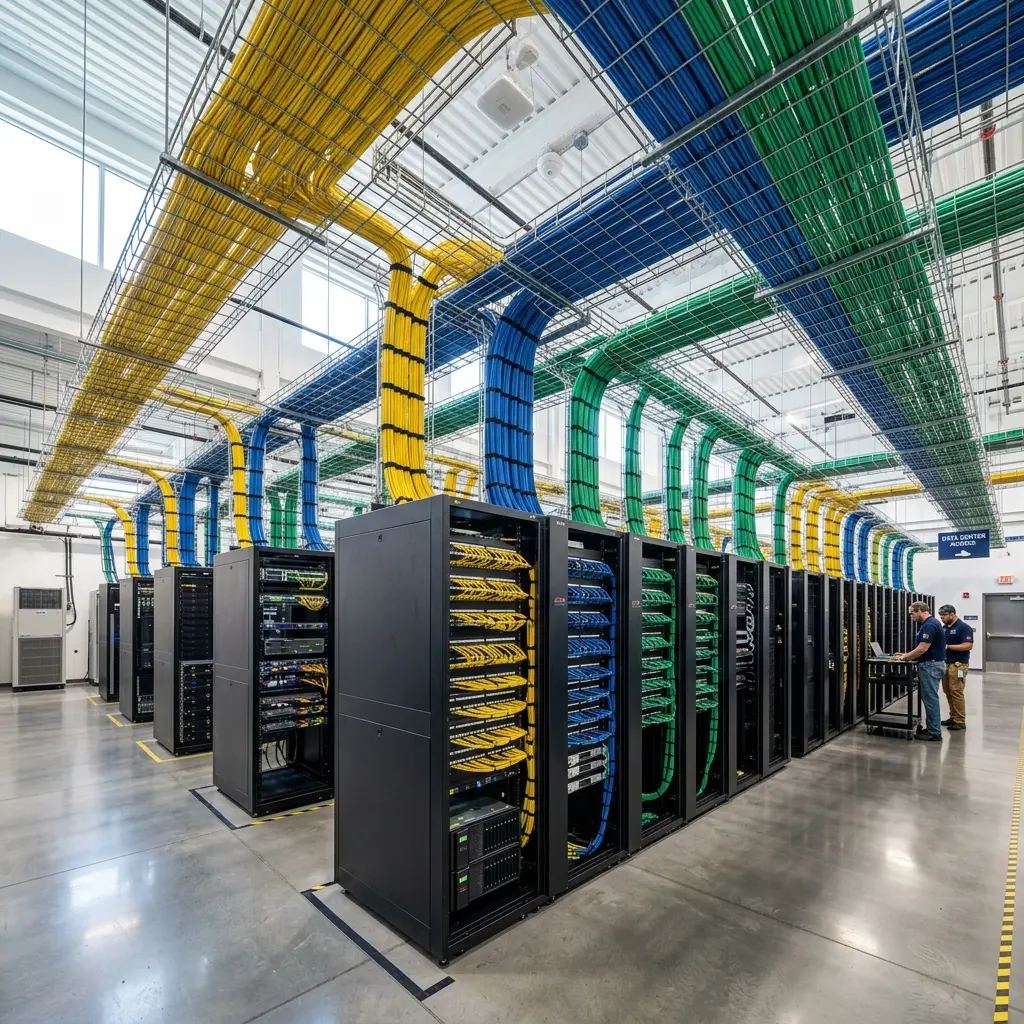
Selecting the right commercial structured cabling configurations is one of the most critical infrastructure decisions for any modern business network
Structured Cabling vs Fiber Optic: Understanding the Core Differences
If you’re running a growing business especially when moving into a new office or upgrading your network infrastructure one of the first major decisions youll face is how to design your internal network backbone. One of the most common comparisons youll encounter is structured cabling vs fiber optic, a decision that directly impacts performance, scalability, and long-term reliability.
In most business environments, structured cabling remains the standard foundation, typically using copper-based systems like Cat6 or Cat6a. Fiber optic cabling is also an option, but it is generally introduced for specific performance or distance requirements rather than as a full replacement.
This isnt a simple either-or decision. Both technologies have strengths, but they serve different roles within a properly designed network. In practice, structured cabling handles the majority of business needs, while fiber supports higher-demand or extended backbone applications.
What makes this decision even more confusing is how it is often marketed. Some vendors position fiber as the universal future-proof solution, while others emphasize the practicality of structured copper systems. The reality of structured cabling vs fiber optic sits in the middle but with a clear baseline.
In this article, youll walk away understanding:
- Why hybrid designs are common in real-world installations
- What each system actually does (and where misunderstandings happen)
- The pros, cons, and costs of structured cabling vs fiber optic
- Why structured cabling remains the standard for most business networks
- When fiber becomes necessary rather than optional
Structured Cabling vs Fiber Optic: Which Is Better for Business
Choosing between structured cabling vs fiber optic can significantly impact your business performance, scalability, and long-term efficiency.
What Exactly Is Structured Cabling?
Structured cabling is the standardized and organized method of building a business network using copper cables (typically Cat5e, Cat6, or Cat6a). It connects workstations, phones, access points, and devices to centralized network hardware such as switches and patch panels.
What makes it structured is not just the cable type, but the design approach consistent labeling, proper cable management, patch panels, and adherence to ANSI/TIA-568 standards. This ensures the network is traceable, scalable, and easier to maintain.
In most office environments, structured cabling includes:
- Horizontal cabling (workstations to network rooms)
- Backbone cabling (between closets or floors where applicable)
- Patch panels and structured termination points
- Racks, cabinets, and labeling systems
In practice, structured cabling forms the core network layer for most commercial buildings, supporting internet access, VoIP systems, security cameras, and office devices reliably.
What About Fiber Optic Cabling?
Fiber optic cabling transmits data using light instead of electrical signals, which changes its performance characteristics significantly.
There are two main types:
- Single-mode fiber (SMF): Designed for long-distance transmission, often used between buildings or across campuses
- Multi-mode fiber (MMF): Used for shorter distances such as within buildings or data centers
Fiber is extremely fast, resistant to electromagnetic interference, and capable of handling very high bandwidth. Because of this, it is commonly used in data centers, backbone connections, and inter-building links.
However, fiber is typically not required for standard office device connections, which is where structured cabling continues to dominate.
Performance Comparison: Copper vs. Fiber
| Feature | Structured Cabling (Copper) | Fiber Optic Cabling |
| Speed | Up to 10 Gbps (Cat6a over 100 m) | 10 Gbps???100 Gbps+ depending on optics |
| Distance | Up to ~100 m per run | Hundreds of meters to kilometers |
| Interference | Susceptible to EMI | Immune to EMI |
| Durability | Flexible and widely supported | More delicate during termination |
| Installation cost | Lower overall cost | Higher due to optics and labor |
| Maintenance | Easier and widely serviceable | Requires specialized tools |
| Best use | Office endpoints and LAN | Backbone and high-demand links |
In most business environments, structured cabling is more than sufficient for everyday operations. Fiber becomes valuable when distance, bandwidth aggregation, or environmental conditions exceed copper???s practical limits.
Where Structured Cabling Is the Standard Choice
In modern office environments, structured cabling remains the most widely used and practical solution.
It is the standard choice when:
1. Your network runs under 100 meters per drop
Cat6a supports up to 10 Gbps at standard distances, which covers most office layouts.
2. Budget efficiency matters
Copper systems are significantly more cost-effective in both materials and installation compared to fiber systems.
3. Ease of maintenance is important
Most IT teams are trained and equipped to install, certify, and troubleshoot copper-based systems efficiently.
4. You are operating within a single building
For most internal office environments, structured cabling provides all necessary performance without complexity.
Structured cabling is often underestimated because it is common???but in reality, it is the most stable and widely deployed foundation for business networks today.
When Fiber Optic Becomes the Right Choice
Fiber optic cabling becomes the appropriate choice in more specific use cases rather than general office deployment.
1. High-bandwidth network environments
Data-heavy operations such as backups, virtualization, or large-scale file transfers benefit from fiber backbone links.
2. Long-term scalability planning
Fiber supports future speed upgrades through optics changes without replacing the physical cable infrastructure.
3. Distance limitations exceed copper standards
Multi-floor buildings, campuses, or distributed sites require fiber to maintain signal integrity over long distances.
4. Electrical interference environments
Industrial settings or areas with heavy electrical equipment benefit from fiber???s immunity to EMI.
Fiber is best understood as a specialized backbone technology, not a replacement for structured cabling in typical office deployments.

Structured Cabling vs Fiber Optic: The Hybrid Approach Used in Most Real Networks
Here???s what???s usually overlooked but matters a lot: it???s not an either/or choice.
Most well-designed networks use a hybrid approach:
- Fiber for the backbone ??? connecting floors, buildings, or network closets.
- Structured cabling for endpoints ??? desktops, phones, Wi-Fi access points, printers, and PoE devices.
This balances cost, simplicity, and scalability: your human-facing endpoints stay on familiar copper, while your core links enjoy fiber???s speed and distance headroom. When growth comes, you mainly upgrade switches and optics, not every horizontal run.
Common Myths and Misconceptions
Let???s clear up a few points that tend to confuse businesses when making this decision.
Myth 1: ???Fiber is always faster.???
In most office environments, users will not experience a performance difference because Cat6a already supports 10 Gbps at standard distances. Real bottlenecks are usually switches, internet service, or configuration???not cabling.
Myth 2: ???Copper is outdated.???
Structured cabling remains fully standardized and widely deployed in commercial buildings. It continues to evolve alongside networking demands and remains highly relevant for business use.
Myth 3: ???Fiber is fragile and impractical.???
While fiber requires careful installation, properly deployed systems are durable and reliable over long periods, especially in protected pathways and structured environments.
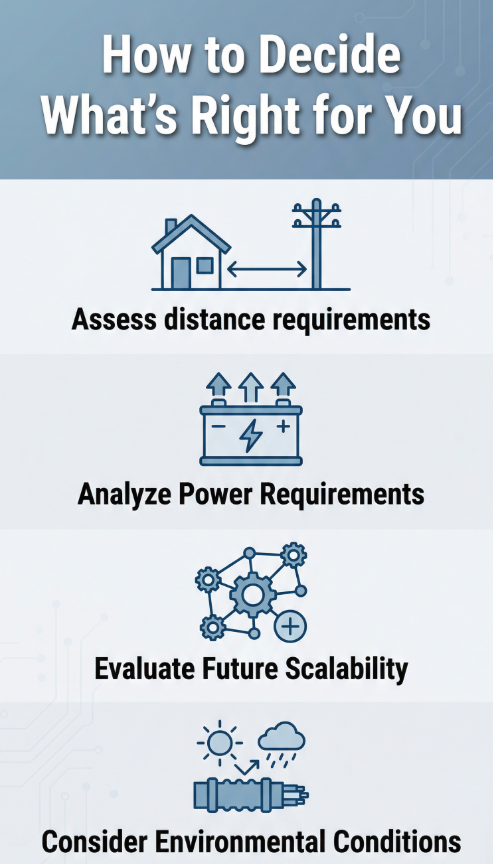
How to Decide What???s Right for You
Choosing between structured cabling vs fiber optic should be based on practical requirements, not trends.
1. Assess distance requirements
Under 100 meters per drop typically favors structured cabling.
2. Evaluate actual performance needs
Most office workloads are fully supported by copper-based 10 Gbps systems.
3. Consider growth plans and infrastructure scale
Fiber becomes valuable in backbone expansion and long-term scalability planning.
4. Review physical building layout
Multi-floor or multi-building setups often benefit from fiber uplinks combined with copper endpoints.
A professional site survey is often the most reliable way to determine the correct design approach.
Summary and Next Steps
Structured cabling remains the primary and most practical foundation for most small and mid-sized business networks, while fiber optic cabling is best suited for backbone, long-distance, and high-capacity links. In most real-world environments, the most efficient and cost-effective network design is a hybrid approach that uses structured cabling for everyday office connections and fiber where higher performance or extended reach is required.
3???5 realistic next steps you can take:
- Measure actual cable run distances across your office layout.
- Separate endpoint connections from backbone connections in your design plan.
- Consult a structured cabling professional familiar with TIA-568 standards.
- Plan certification testing for installed cable runs to ensure performance consistency.
- Maintain proper documentation and labeling for future scalability and troubleshooting.
In the end, the goal is not choosing between copper and fiber as competitors???it is designing a stable, scalable network where each technology is used in its proper role. For most businesses, structured cabling forms the foundation that everything else builds on. If you???re planning a new installation or upgrading your network, Efficient Low Voltage Solutions & System Integration provides professional structured cabling services designed for reliability, scalability, and long-term performance???helping your business build a network that simply works the way it should from day one.
Structured Cabling vs Point to Point: What???s the Difference and Why It Matters
Every modern network depends on a reliable cabling infrastructure. Whether supporting office computers, security systems, wireless access points, VoIP phones, or data center equipment, the way cables are designed and organized plays a major role in network performance and long-term efficiency. While many organizations focus on networking hardware and internet speeds, the cabling foundation often determines how easily a network can grow, adapt, and remain reliable over time.
One of the most common discussions in network infrastructure planning is structured cabling vs point to point. At first glance, both approaches appear to accomplish the same goal: connecting devices so they can communicate. However, the differences become much more apparent as networks expand and operational demands increase. Understanding structured cabling vs point to point helps organizations make informed decisions that support scalability, maintenance, performance, and future growth.
What Is a Structured Cabling System?
A structured cabling system is a standardized approach to designing and organizing network infrastructure. Instead of creating direct cable connections between every device, structured cabling uses a centralized architecture that allows devices to connect through organized pathways and distribution points.
The goal is to create a network environment that is:
- Organized
- Scalable
- Flexible
- Easy to maintain
- Ready for future technologies
Structured cabling follows industry standards that promote consistency and simplify network management.
Main Components of Structured Cabling
A structured cabling system commonly includes:
- Horizontal cabling
- Backbone cabling
- Patch panels
- Telecommunications rooms
- Equipment rooms
- Network racks
- Cable management systems
- Work area outlets
Each component serves a specific purpose, creating a cohesive infrastructure that supports efficient communication throughout a building or campus.
Why Structured Cabling Became the Industry Standard
As businesses became more dependent on technology, network complexity increased dramatically. Managing hundreds or thousands of direct cable connections became inefficient and difficult to maintain.
Structured cabling emerged as a solution because it provides:
- Better cable organization
- Easier troubleshooting
- Faster upgrades
- Improved scalability
- Reduced downtime
These advantages have made structured cabling the preferred choice for many commercial environments.
What Is Point-to-Point Cabling?
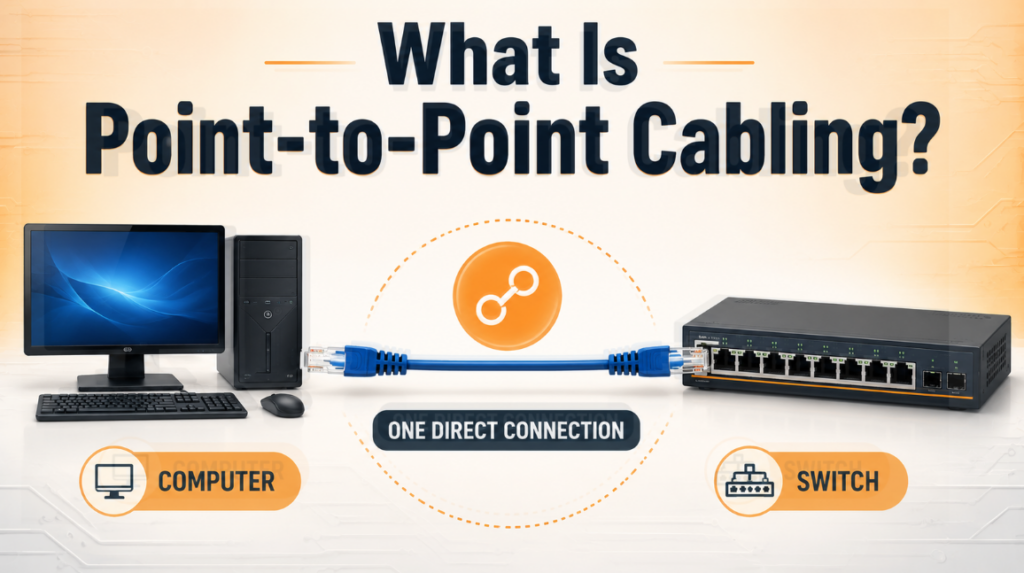
Point-to-point cabling is a simpler approach that connects one device directly to another using a dedicated cable. Rather than routing connections through patch panels or centralized infrastructure, each cable serves a specific connection between two endpoints.
Examples include:
- Computer to switch
- Camera to recorder
- Server to network appliance
- Controller to industrial equipment
The concept is straightforward and often works well for small installations.
How Point-to-Point Networks Are Built
Each time a new device is added, another cable is installed between the device and its destination.
This often results in:
- Large cable bundles
- Multiple cable pathways
- Increased cable density
- Limited organization
While manageable in smaller environments, complexity can increase quickly as additional devices are added.
Structured Cabling vs Point to Point: Understanding the Fundamental Difference
The primary difference in structured cabling vs point to point is the overall design philosophy.
Structured cabling focuses on creating an organized infrastructure capable of supporting growth and changes over time.
Point-to-point cabling focuses on creating direct device connections with minimal supporting infrastructure.
Structured Cabling Approach
Characteristics include:
- Centralized network design
- Standardized installation methods
- Organized cable routing
- Easy expansion capabilities
- Simplified management
Point-to-Point Approach
Characteristics include:
- Direct device connections
- Limited infrastructure requirements
- Fast deployment
- Lower initial setup complexity
- Greater management challenges as networks grow
The distinction becomes increasingly important as network demands evolve.
Structured Cabling vs Point to Point: Installation Considerations
Installation requirements vary significantly between the two approaches.
Structured Cabling Installation Process
Structured cabling projects often involve:
- Site assessments
- Infrastructure planning
- Cable pathway design
- Rack installation
- Patch panel configuration
- Cable labeling
- Documentation
The process requires careful planning but results in a highly organized network environment.
Point-to-Point Installation Process
Point-to-point installations generally involve:
- Running direct cable connections
- Connecting endpoints
- Testing connectivity
The process is straightforward and often requires less upfront planning.
Which Installation Method Is Simpler?
For very small networks, point-to-point installation is usually simpler.
However, as device counts increase, structured cabling often becomes easier to manage because future additions can be integrated without extensive rewiring.
Structured Cabling vs Point to Point: Scalability and Growth
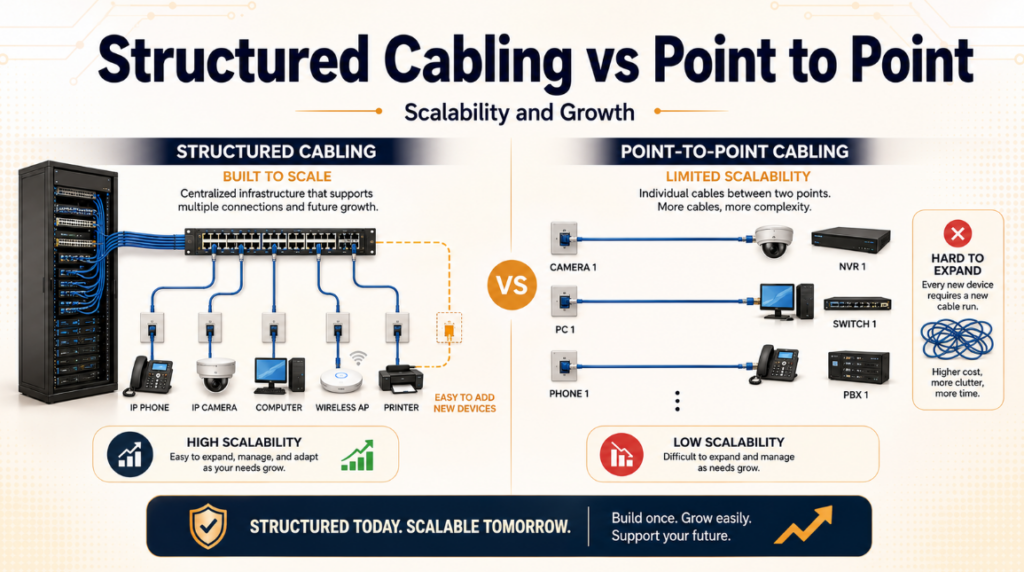
Scalability is one of the most significant factors when evaluating structured cabling vs point to point.
Structured Cabling Supports Expansion
A structured cabling system is designed with future growth in mind.
Benefits include:
- Easy addition of new users
- Faster deployment of new technologies
- Simplified office expansions
- Reduced disruption during upgrades
Organizations can often expand their networks without redesigning the entire infrastructure.
Point-to-Point Challenges During Growth
As point-to-point networks expand, several challenges may emerge:
- Cable congestion
- Increased installation time
- Difficult cable tracing
- Reduced visibility
- Greater risk of errors
What begins as a simple network can eventually become difficult to manage.
H4: Why Growth Planning Matters
Network requirements rarely remain static. Businesses frequently add employees, devices, applications, and security systems. Choosing a cabling strategy that accommodates growth can prevent costly redesigns later.
Structured Cabling vs Point to Point: Maintenance and Troubleshooting
Maintaining a network becomes easier when infrastructure is organized and well documented.
Structured Cabling Maintenance Advantages
Structured cabling offers several maintenance benefits:
- Clearly labeled cables
- Organized patch panels
- Centralized network equipment
- Standardized layouts
- Easier documentation
These features help technicians identify and resolve issues quickly.
Point-to-Point Maintenance Challenges
Point-to-point systems may become difficult to troubleshoot because:
- Cables may not be labeled consistently
- Connections can be difficult to trace
- Cable bundles can become crowded
- Documentation may be limited
As networks grow, locating a single faulty cable may require considerable effort.
Structured Cabling vs Point to Point: Cable Management Differences
Cable management is often overlooked until network changes become necessary.
Organized Infrastructure with Structured Cabling
Structured cabling promotes:
- Neat cable routing
- Consistent labeling
- Better airflow around equipment
- Cleaner equipment rooms
- Improved accessibility
A well-organized environment reduces confusion and simplifies future modifications.
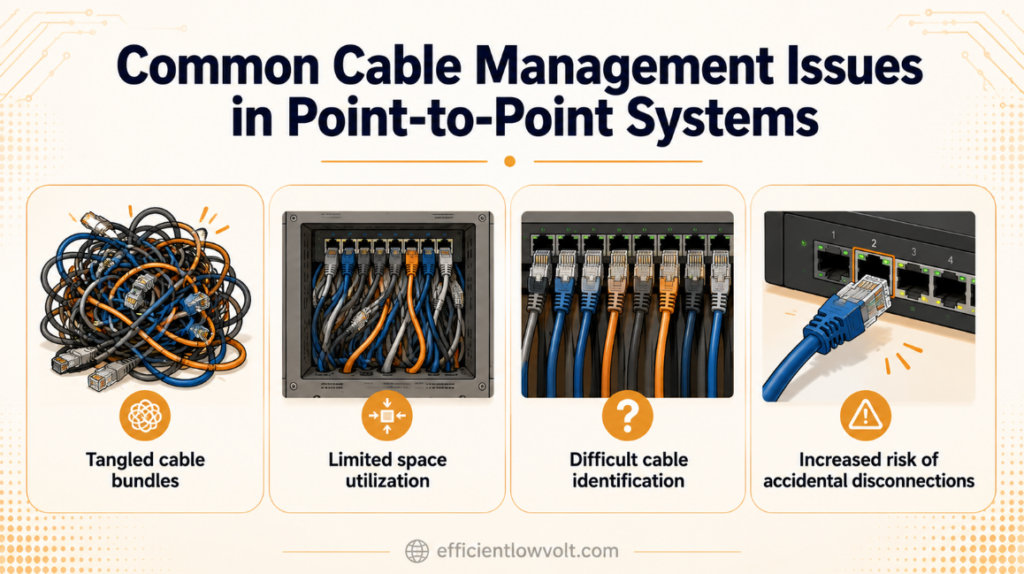
Common Cable Management Issues in Point-to-Point Systems
Without centralized organization, point-to-point installations can experience:
- Tangled cable bundles
- Limited space utilization
- Difficult cable identification
- Increased risk of accidental disconnections
These issues can become more noticeable as additional equipment is added.
Structured Cabling vs Point to Point: Cost Comparison
Cost is often a deciding factor when selecting a cabling strategy.
Initial Investment
Point-to-point cabling often requires:
- Fewer components
- Less planning
- Faster deployment
As a result, upfront costs are typically lower.
Structured cabling generally requires:
- Patch panels
- Racks
- Cable management systems
- Design planning
- Documentation
These elements increase the initial investment.
Long-Term Financial Impact
Although structured cabling may cost more initially, long-term savings often result from:
- Easier maintenance
- Faster troubleshooting
- Simplified upgrades
- Reduced labor costs
Point-to-point systems may become more expensive over time as network complexity increases.
Looking Beyond Installation Costs
Evaluating only upfront expenses can be misleading. Total ownership costs often provide a more accurate picture of long-term value.
Structured Cabling vs Point to Point: Performance and Reliability
Network performance depends on many factors, including equipment quality, installation practices, and cable standards.
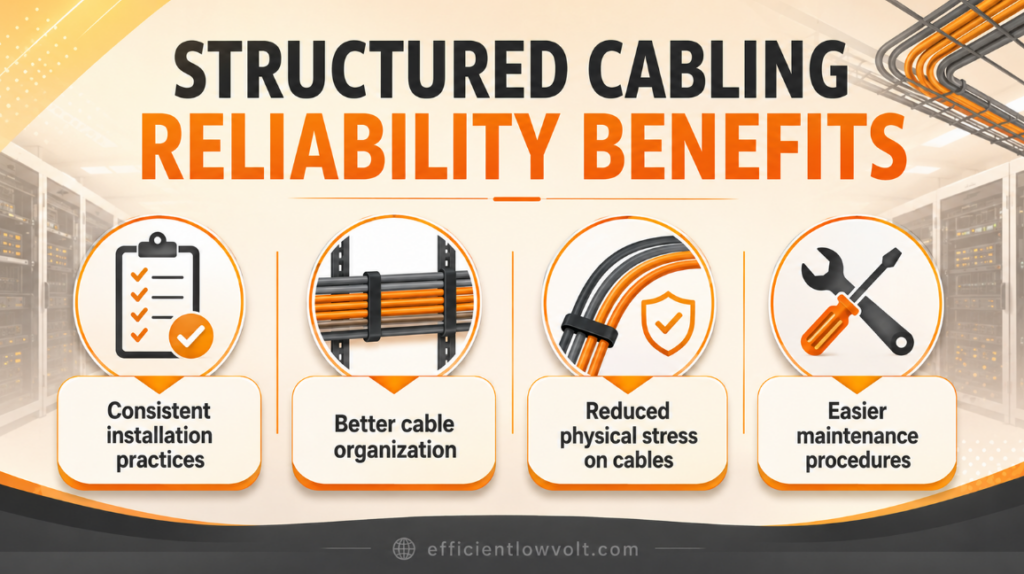
Structured Cabling Reliability Benefits
Structured cabling can improve reliability through:
- Consistent installation practices
- Better cable organization
- Reduced physical stress on cables
- Easier maintenance procedures
These factors help maintain stable network performance.
Point-to-Point Performance Considerations
Point-to-point connections can deliver excellent performance in smaller environments.
However, larger installations may experience challenges related to cable management, maintenance efficiency, and network modifications.
When Structured Cabling Is the Better Choice
Structured cabling is often ideal when:
- Long-term growth is expected
- Multiple departments share network resources
- Downtime must be minimized
- Network changes occur regularly
- Future technology upgrades are anticipated
These environments benefit from the flexibility and organization that structured cabling provides.
When Point-to-Point Cabling May Still Be Useful
Point-to-point cabling remains suitable for certain situations.
Examples include:
- Small offices
- Temporary facilities
- Single-purpose systems
- Industrial equipment connections
- Limited-scale installations
In these scenarios, the simplicity of direct connections may outweigh scalability concerns.
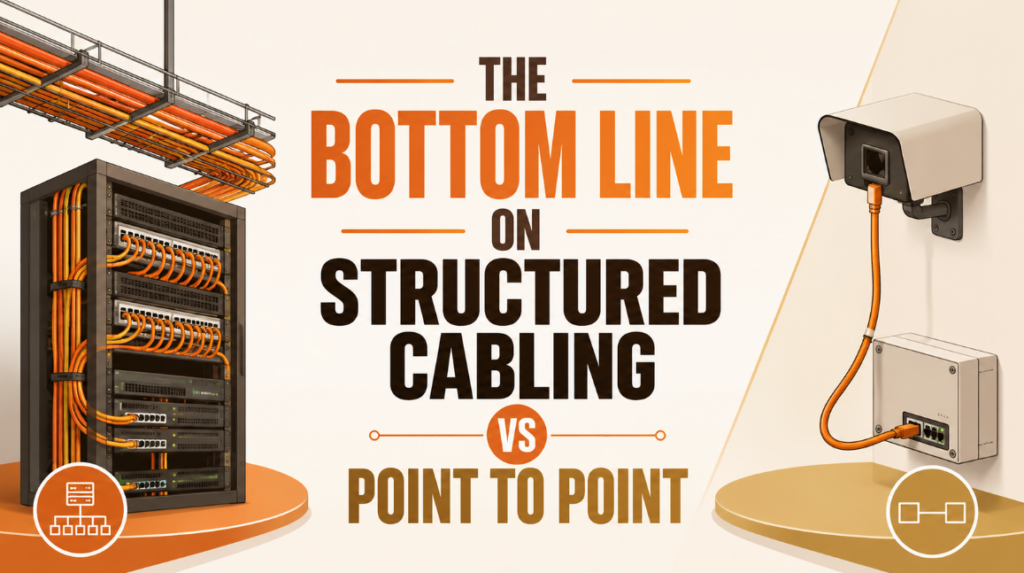
The Bottom Line on Structured Cabling vs Point to Point
When comparing structured cabling vs point to point, the right choice depends largely on network size, future growth expectations, and operational requirements. Point-to-point cabling offers simplicity and lower initial costs, making it practical for smaller environments. Structured cabling, on the other hand, provides a standardized framework that simplifies maintenance, supports expansion, and improves long-term network management. As networks become more complex, the advantages of structured cabling become increasingly valuable.
Build a Network That Supports Tomorrow???s Demands
Understanding the differences between structured cabling vs point to point can help organizations avoid costly infrastructure challenges in the future. A well-designed cabling system contributes to reliability, scalability, and easier maintenance, all of which play important roles in supporting modern technology environments. Evaluating current needs alongside future growth plans is essential when selecting the most effective cabling strategy.
For organizations seeking dependable structured cabling solutions, Efficient LowVolt Solutions provides professional expertise in designing and implementing organized network infrastructures that support long-term performance, flexibility, and business growth. A properly planned cabling system today can help create a stronger and more adaptable network for years to come.
Structured Cabling vs Traditional Wiring: Which One Saves You More in the Long Run
In today???s digital-driven world, a stable and efficient network isn???t just an advantage???it???s the backbone of every modern business operation. Whether you???re managing a corporate office, retail store, or data center, your network infrastructure determines how well your technology communicates, how efficiently your systems perform, and ultimately, how smoothly your business runs.
When building or upgrading that infrastructure, one key decision often comes up: Should you stick with traditional wiring or invest in structured cabling?
At first glance, traditional wiring may seem more affordable, especially for smaller setups. However, as your organization grows and technology evolves, that initial saving can turn into long-term frustration and hidden costs. Structured cabling, on the other hand, is designed with growth, organization, and reliability in mind.
This article explores the real differences between structured cabling and traditional wiring???helping you understand which option truly saves you more in the long run.
The Basics: Structured Cabling vs Traditional Wiring
Before comparing costs and benefits, it???s important to understand how each system works and what sets them apart.
What is Structured Cabling?
Structured cabling is a standardized system designed to support multiple hardware uses, making your network more organized and easier to manage. It consists of components such as horizontal cabling, backbone cabling, patch panels, outlets, and telecommunications rooms???all working together under industry standards like ANSI/TIA/EIA.
Each cable and connection point is labeled, neatly arranged, and strategically planned for future scalability. This makes structured cabling the preferred choice for businesses, data centers, and institutions that need high-speed connectivity and seamless integration across devices.
What is Traditional Wiring?
Traditional wiring, often called point-to-point cabling, connects devices directly to each other or to the network equipment. It???s a less organized, more ad-hoc approach???common in older buildings or small setups. While it can work for limited systems, it quickly becomes cluttered and hard to maintain as the network grows.
Key Differences at a Glance:
| Feature | Structured Cabling | Traditional Wiring |
| Design | Standardized, organized | Random, point-to-point |
| Scalability | Highly scalable | Limited |
| Maintenance | Easy to trace and manage | Time-consuming |
| Performance | Consistent and high-speed | May degrade over time |
| Cost Efficiency | High ROI over time | Low initial cost, high upkeep |
Structured cabling may require more upfront investment, but its design efficiency and long-term performance make it a smarter choice for growing businesses.
Cost Comparison: Upfront vs Long-Term Investment
When choosing between the two, cost is often the first concern. It???s true???traditional wiring usually costs less initially, but that???s only part of the story.
Upfront Costs
Traditional wiring is appealing for small installations because it doesn???t require complex planning. Cables are simply connected where needed, reducing immediate labor and material costs. However, this lack of structure leads to inefficiencies later on.
Structured cabling, in contrast, involves design, labeling, and testing by certified installers. While the initial investment may be higher, this professional setup reduces future costs related to maintenance, downtime, and expansion.
Hidden Costs of Traditional Wiring
Over time, point-to-point systems create chaos???tangled cables, interference, and difficulty identifying connections. Each time your business adds devices, rearranges workstations, or experiences downtime, costs accumulate. Troubleshooting becomes time-intensive, often requiring full rewiring or service interruptions.
Long-Term Savings with Structured Cabling
Structured cabling minimizes these problems. Its organized layout allows for:
- Reduced downtime due to faster problem identification
- Simpler upgrades without disrupting existing systems
- Lower maintenance costs
- Greater ROI as your system supports future technology without major changes
Ultimately, while traditional wiring seems cheaper at first, structured cabling pays for itself within a few years through efficiency and reliability.
Performance and Reliability: Meeting Modern Demands

Today???s business environment depends on speed, bandwidth, and stability. Video conferencing, cloud computing, smart security systems, and IoT devices all rely on strong network performance.
Traditional Wiring Limitations
Traditional cabling setups often struggle with high bandwidth demands. Unorganized cables can cause signal interference, crosstalk, and inconsistent data speeds. Moreover, when a connection fails, identifying and fixing the issue becomes tedious, impacting productivity.
Structured Cabling Advantages
Structured cabling systems are built for high performance and reliability. Each cable follows precise standards, ensuring minimal interference and consistent connectivity. They can handle data, voice, and video transmissions over one system???supporting fast, stable communication across your entire network.
Structured cabling also complies with TIA/EIA and ISO/IEC standards, meaning you get guaranteed performance and compatibility across future technologies. For businesses that depend on reliable uptime, structured cabling delivers a measurable performance advantage.
Scalability and Future-Proofing: Growing with Your Business
Growth is inevitable for most organizations. When you hire new employees, expand to new floors, or adopt new technologies, your network must evolve with you.
Traditional Wiring Challenges
Adding new devices to a traditional wiring setup often requires re-routing cables or installing new lines???a process that disrupts workflow and adds labor costs. Because there???s no structured plan, scalability is limited and messy.
Structured Cabling Advantages
Structured cabling is designed for change. Its modular layout means you can easily add or move devices without major rewiring. Whether you???re upgrading to higher-speed connections or integrating smart technologies, structured cabling provides the flexibility you need.
This makes it a future-proof investment???a one-time infrastructure that adapts to new hardware, technologies, and company growth without repeated overhauls.
Maintenance, Troubleshooting, and Downtime: The Hidden Cost Factor

Maintenance and troubleshooting often determine how much your network truly costs over time.
Traditional Wiring Issues
In a traditional wiring system, cables are often unlabeled and tangled. When something goes wrong, technicians must manually trace each line???a time-consuming process that extends downtime. This not only delays operations but can also result in lost business and reduced productivity.
Structured Cabling Efficiency
Structured cabling, on the other hand, is built for simplicity. Every cable and connection point is clearly labeled and organized. When a problem arises, it can be identified and fixed within minutes, not hours.
This level of efficiency drastically reduces downtime, lowers maintenance labor costs, and ensures consistent business continuity.
The Downtime Cost Reality
Every minute your network is down costs money???through lost communication, unprocessed sales, or interrupted workflows. Structured cabling???s reliability and traceability help prevent such losses, reinforcing its value beyond just installation cost.
Aesthetic and Safety Benefits: Order Meets Compliance
While performance is essential, the physical condition of your network cabling also plays a major role in safety and maintenance.
Traditional Wiring Concerns
Messy, unorganized cables aren???t just unsightly???they can be hazardous. Poor airflow leads to equipment overheating, tangled wires increase fire risks, and unstructured layouts may violate building or IT safety codes.
Structured Cabling Solutions
Structured cabling systems prioritize neatness and safety. Organized racks and labeled pathways ensure:
- Improved airflow, reducing equipment strain
- Easier access for upgrades or inspections
- Compliance with safety and fire codes
A clean, organized setup also reflects professionalism and instills confidence in clients and partners visiting your facility.
Environmental and Sustainability Considerations

In an era where sustainability matters, structured cabling aligns with eco-friendly goals better than traditional wiring.
Traditional Wiring Drawbacks
Frequent rewiring and cable replacements contribute to material waste. Outdated cables are often discarded instead of being repurposed, adding to environmental impact.
Structured Cabling Sustainability
Structured cabling has a longer lifespan???usually 10 to 15 years???meaning fewer replacements and less waste. Its compatibility with energy-efficient systems like Power over Ethernet (PoE) and smart building technologies further supports sustainability goals.
By reducing the need for constant replacements and minimizing power inefficiencies, structured cabling helps businesses reduce their carbon footprint while maintaining high performance.
Real-World Scenarios: Where Structured Cabling Proves Its Worth
- Corporate Office Expansion: A company with 50 employees installs structured cabling during office setup. When it grows to 150 employees, new devices are added effortlessly through existing panels???no downtime, no rewiring.
- Educational Institutions: Schools and universities rely on structured cabling to support Wi-Fi, smart classrooms, and security systems across multiple buildings. It allows seamless connectivity for thousands of users.
- Data Centers: Data centers are prime examples of structured cabling efficiency. Organized patch panels and standardized layouts allow technicians to manage thousands of connections without confusion or service interruptions.
- Small Businesses: Even small offices benefit. While traditional wiring may seem cheaper at first, structured cabling eliminates future reinstallation costs???making it the more affordable option long-term.
These real-world scenarios show that regardless of business size, structured cabling ensures consistency, flexibility, and cost efficiency.
Making the Right Choice for Your Business

When weighing both systems, the answer depends on your long-term vision.
If you only need a short-term, low-cost setup for a very small operation, traditional wiring might suffice temporarily. But if your goal is to build a reliable, scalable network that supports business growth, structured cabling is the clear winner.
The Bottom Line:
- Traditional wiring: Low upfront cost, high long-term expense.
- Structured cabling: Higher initial investment, lower lifetime cost and downtime.
Structured cabling ensures future readiness, compliance, and easier management???saving both money and stress over time. With technology evolving rapidly, investing in structured cabling today prevents unnecessary upgrades tomorrow.
Final Thoughts: Invest Smart, Connect Strong
Structured cabling is more than a network???it???s an investment in your business continuity, efficiency, and future growth. It delivers cleaner installations, consistent performance, and the flexibility to adapt to new technologies without costly overhauls.
In contrast, traditional wiring might seem economical at first, but its maintenance challenges and scalability limitations often cost far more in the long run.
At Efficient Low Voltage Solutions & System Integration, we design and install structured cabling systems that grow with your business???ensuring robust, secure, and future-ready connectivity. From planning to installation, our experts ensure every cable supports your performance goals today and tomorrow.
Invest smart. Build strong. Choose structured cabling that stands the test of time.