
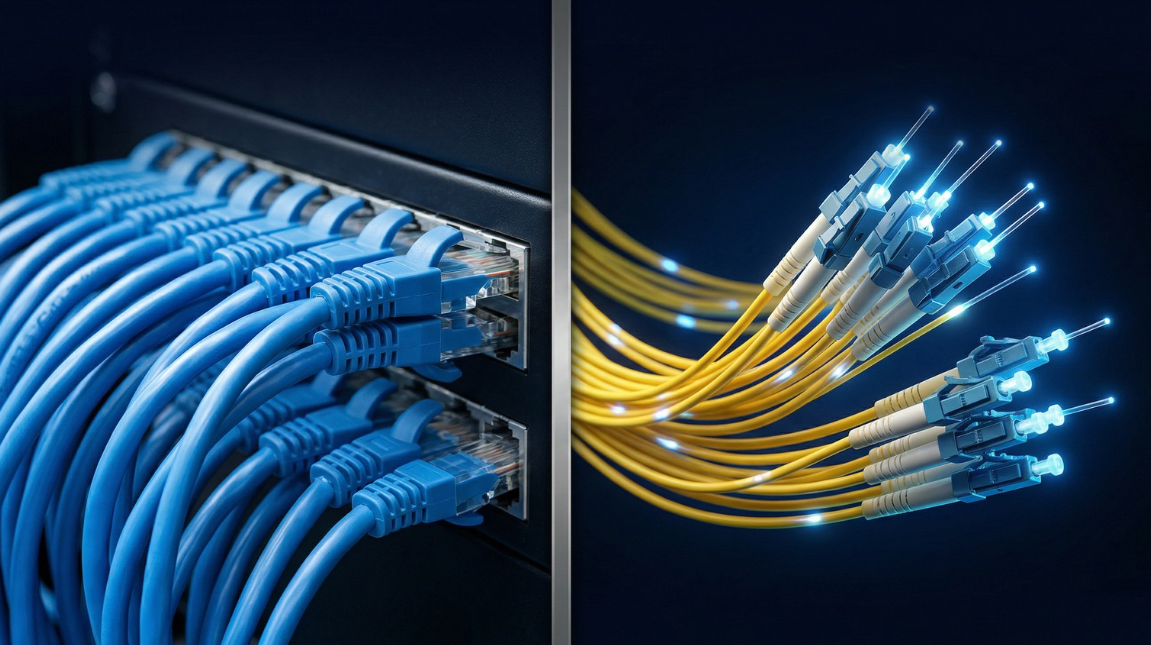
If you’re running a growing business—especially when moving into a new office or upgrading your network infrastructure—one of the first major decisions you’ll face is how to design your internal network backbone. One of the most common comparisons you’ll encounter is structured cabling vs fiber optic, a decision that directly impacts performance, scalability, and long-term reliability.
In most business environments, structured cabling remains the standard foundation, typically using copper-based systems like Cat6 or Cat6a. Fiber optic cabling is also an option, but it is generally introduced for specific performance or distance requirements rather than as a full replacement.
This isn’t a simple “either-or” decision. Both technologies have strengths, but they serve different roles within a properly designed network. In practice, structured cabling handles the majority of business needs, while fiber supports higher-demand or extended backbone applications.
What makes this decision even more confusing is how it is often marketed. Some vendors position fiber as the universal “future-proof” solution, while others emphasize the practicality of structured copper systems. The reality of structured cabling vs fiber optic sits in the middle—but with a clear baseline.
In this article, you’ll walk away understanding:
- Why hybrid designs are common in real-world installations
- What each system actually does (and where misunderstandings happen)
- The pros, cons, and costs of structured cabling vs fiber optic
- Why structured cabling remains the standard for most business networks
- When fiber becomes necessary rather than optional
Structured Cabling vs Fiber Optic: Which Is Better for Business
Choosing between structured cabling vs fiber optic can significantly impact your business performance, scalability, and long-term efficiency.
What Exactly Is Structured Cabling?
Structured cabling is the standardized and organized method of building a business network using copper cables (typically Cat5e, Cat6, or Cat6a). It connects workstations, phones, access points, and devices to centralized network hardware such as switches and patch panels.
What makes it “structured” is not just the cable type, but the design approach—consistent labeling, proper cable management, patch panels, and adherence to ANSI/TIA-568 standards. This ensures the network is traceable, scalable, and easier to maintain.
In most office environments, structured cabling includes:
- Horizontal cabling (workstations to network rooms)
- Backbone cabling (between closets or floors where applicable)
- Patch panels and structured termination points
- Racks, cabinets, and labeling systems
In practice, structured cabling forms the core network layer for most commercial buildings, supporting internet access, VoIP systems, security cameras, and office devices reliably.
What About Fiber Optic Cabling?
Fiber optic cabling transmits data using light instead of electrical signals, which changes its performance characteristics significantly.
There are two main types:
- Single-mode fiber (SMF): Designed for long-distance transmission, often used between buildings or across campuses
- Multi-mode fiber (MMF): Used for shorter distances such as within buildings or data centers
Fiber is extremely fast, resistant to electromagnetic interference, and capable of handling very high bandwidth. Because of this, it is commonly used in data centers, backbone connections, and inter-building links.
However, fiber is typically not required for standard office device connections, which is where structured cabling continues to dominate.
Performance Comparison: Copper vs. Fiber
| Feature | Structured Cabling (Copper) | Fiber Optic Cabling |
| Speed | Up to 10 Gbps (Cat6a over 100 m) | 10 Gbps–100 Gbps+ depending on optics |
| Distance | Up to ~100 m per run | Hundreds of meters to kilometers |
| Interference | Susceptible to EMI | Immune to EMI |
| Durability | Flexible and widely supported | More delicate during termination |
| Installation cost | Lower overall cost | Higher due to optics and labor |
| Maintenance | Easier and widely serviceable | Requires specialized tools |
| Best use | Office endpoints and LAN | Backbone and high-demand links |
In most business environments, structured cabling is more than sufficient for everyday operations. Fiber becomes valuable when distance, bandwidth aggregation, or environmental conditions exceed copper’s practical limits.
Where Structured Cabling Is the Standard Choice
In modern office environments, structured cabling remains the most widely used and practical solution.
It is the standard choice when:
1. Your network runs under 100 meters per drop
Cat6a supports up to 10 Gbps at standard distances, which covers most office layouts.
2. Budget efficiency matters
Copper systems are significantly more cost-effective in both materials and installation compared to fiber systems.
3. Ease of maintenance is important
Most IT teams are trained and equipped to install, certify, and troubleshoot copper-based systems efficiently.
4. You are operating within a single building
For most internal office environments, structured cabling provides all necessary performance without complexity.
Structured cabling is often underestimated because it is common—but in reality, it is the most stable and widely deployed foundation for business networks today.
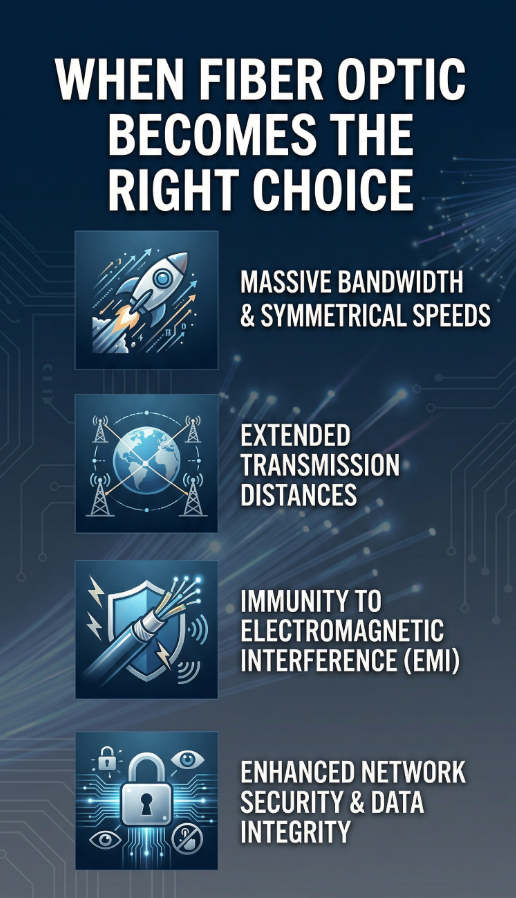
When Fiber Optic Becomes the Right Choice
Fiber optic cabling becomes the appropriate choice in more specific use cases rather than general office deployment.
1. High-bandwidth network environments
Data-heavy operations such as backups, virtualization, or large-scale file transfers benefit from fiber backbone links.
2. Long-term scalability planning
Fiber supports future speed upgrades through optics changes without replacing the physical cable infrastructure.
3. Distance limitations exceed copper standards
Multi-floor buildings, campuses, or distributed sites require fiber to maintain signal integrity over long distances.
4. Electrical interference environments
Industrial settings or areas with heavy electrical equipment benefit from fiber’s immunity to EMI.
Fiber is best understood as a specialized backbone technology, not a replacement for structured cabling in typical office deployments.
Structured Cabling vs Fiber Optic: The Hybrid Approach Used in Most Real Networks
Here’s what’s usually overlooked but matters a lot: it’s not an either/or choice.
Most well-designed networks use a hybrid approach:
- Fiber for the backbone — connecting floors, buildings, or network closets.
- Structured cabling for endpoints — desktops, phones, Wi-Fi access points, printers, and PoE devices.
This balances cost, simplicity, and scalability: your human-facing endpoints stay on familiar copper, while your core links enjoy fiber’s speed and distance headroom. When growth comes, you mainly upgrade switches and optics, not every horizontal run.
Common Myths and Misconceptions
Let’s clear up a few points that tend to confuse businesses when making this decision.
Myth 1: “Fiber is always faster.”
In most office environments, users will not experience a performance difference because Cat6a already supports 10 Gbps at standard distances. Real bottlenecks are usually switches, internet service, or configuration—not cabling.
Myth 2: “Copper is outdated.”
Structured cabling remains fully standardized and widely deployed in commercial buildings. It continues to evolve alongside networking demands and remains highly relevant for business use.
Myth 3: “Fiber is fragile and impractical.”
While fiber requires careful installation, properly deployed systems are durable and reliable over long periods, especially in protected pathways and structured environments.
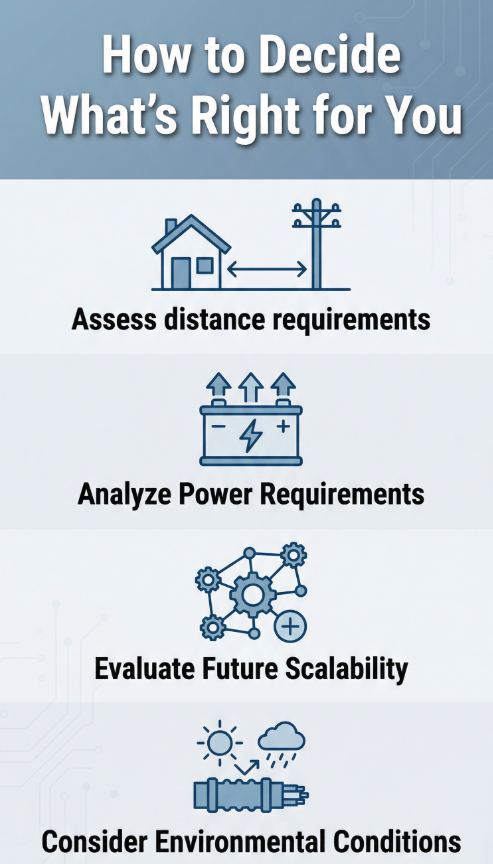
How to Decide What’s Right for You
Choosing between structured cabling vs fiber optic should be based on practical requirements, not trends.
1. Assess distance requirements
Under 100 meters per drop typically favors structured cabling.
2. Evaluate actual performance needs
Most office workloads are fully supported by copper-based 10 Gbps systems.
3. Consider growth plans and infrastructure scale
Fiber becomes valuable in backbone expansion and long-term scalability planning.
4. Review physical building layout
Multi-floor or multi-building setups often benefit from fiber uplinks combined with copper endpoints.
A professional site survey is often the most reliable way to determine the correct design approach.
Summary and Next Steps
Structured cabling remains the primary and most practical foundation for most small and mid-sized business networks, while fiber optic cabling is best suited for backbone, long-distance, and high-capacity links. In most real-world environments, the most efficient and cost-effective network design is a hybrid approach that uses structured cabling for everyday office connections and fiber where higher performance or extended reach is required.
3–5 realistic next steps you can take:
- Measure actual cable run distances across your office layout.
- Separate endpoint connections from backbone connections in your design plan.
- Consult a structured cabling professional familiar with TIA-568 standards.
- Plan certification testing for installed cable runs to ensure performance consistency.
- Maintain proper documentation and labeling for future scalability and troubleshooting.
In the end, the goal is not choosing between copper and fiber as competitors—it is designing a stable, scalable network where each technology is used in its proper role. For most businesses, structured cabling forms the foundation that everything else builds on. If you’re planning a new installation or upgrading your network, Efficient Lowvolt Solutions provides professional structured cabling services designed for reliability, scalability, and long-term performance—helping your business build a network that simply works the way it should from day one.