
In today’s connected world, WiFi is no longer a convenience it’s a critical business asset. Organizations rely on wireless connectivity for cloud applications, communication tools, customer interactions, security systems, and countless day-to-day operations. Yet many businesses underestimate the true impact of poor WiFi performance. Slow speeds, unreliable connections, and coverage gaps can create far-reaching consequences that extend well beyond employee frustration. These issues can reduce productivity, disrupt operations, affect customer satisfaction, and ultimately impact revenue.
Whether you’re operating a small office, a retail store, a healthcare facility, or a large commercial property, the quality of your wireless network plays a direct role in how effectively your business functions. Understanding the hidden costs of poor WiFi can help organizations make informed decisions about network upgrades, optimization, and long-term technology planning.
How Poor WiFi Affects Employee Productivity
Employees depend on reliable internet access throughout the workday. From sending emails and participating in video meetings to accessing cloud-based applications and sharing files, nearly every business process requires stable connectivity.
When WiFi performance suffers, productivity often declines.
1. Delayed Access to Cloud Applications
Many organizations have migrated critical operations to cloud-based platforms. Customer relationship management systems, project management tools, accounting software, and collaboration platforms all require dependable internet access.
When employees experience slow loading times or intermittent connectivity, simple tasks take longer to complete. While a few seconds may seem insignificant, these delays accumulate over days, weeks, and months, creating measurable productivity losses across an entire organization.
2. Interrupted Video Meetings
Video conferencing has become a standard part of modern business communication. Poor WiFi can result in frozen screens, dropped calls, distorted audio, and lagging video.
These interruptions affect communication quality and can create misunderstandings, wasted meeting time, and frustration among employees, clients, and business partners.
3. Reduced Collaboration Efficiency
Modern teams frequently collaborate using cloud storage systems and real-time communication tools. Slow WiFi can delay file uploads, hinder document sharing, and create synchronization issues.
When collaboration tools fail to perform as expected, employees spend more time troubleshooting and less time focusing on productive work.
4. Increased Employee Frustration
Technology challenges can negatively impact employee morale. Constant connectivity issues force workers to repeatedly reconnect devices, restart applications, or seek assistance from IT personnel.
Over time, these recurring frustrations can affect workplace satisfaction and overall efficiency.
Customer Experience Suffers More Than You Think

Many businesses focus primarily on how WiFi affects employees. However, customers often experience the consequences as well.
Guest WiFi Expectations
Customers increasingly expect fast, reliable guest WiFi when visiting offices, retail stores, restaurants, hotels, and service locations.
When guest networks perform poorly, visitors may associate the negative experience with the business itself. Slow internet access can leave customers with the impression that a company is outdated, unprofessional, or inattentive to their needs.
Longer Wait Times
Many customer-facing businesses rely on wireless systems to process transactions, access inventory information, schedule appointments, and communicate with staff.
Poor connectivity can slow these processes, leading to longer wait times and reduced customer satisfaction.
Negative Online Reviews
Customers who experience persistent technology issues may share their frustrations online. Negative reviews can influence future purchasing decisions and impact a company’s reputation.
While businesses often focus on products and services, the quality of the customer experience increasingly includes the reliability of digital infrastructure.
The Revenue Cost of Network Downtime
One of the most overlooked consequences of poor WiFi is its direct impact on revenue.
Lost Sales Opportunities
Businesses that rely on wireless connectivity for sales transactions may experience interruptions that prevent purchases from being completed efficiently.
If customers encounter delays or technical difficulties during the buying process, some may choose to leave without making a purchase.
Reduced Staff Efficiency
When employees cannot access the tools they need, productivity declines. Tasks take longer to complete, customer requests remain unresolved, and operational efficiency suffers.
Over time, these inefficiencies can contribute to increased labor costs and reduced profitability.
Missed Business Opportunities
Reliable communication is essential for maintaining relationships with clients and prospects. Missed video calls, delayed responses, and connectivity interruptions can affect customer trust and potentially result in lost business opportunities.
While these losses may not always be immediately visible, they can have a substantial long-term impact.
Poor WiFi Creates IT and Operational Bottlenecks
Slow wireless networks often place additional strain on IT departments and operational teams.
Increased Support Requests
Employees experiencing connectivity problems frequently submit support tickets or request assistance from IT personnel.
As support requests increase, IT teams spend more time troubleshooting recurring WiFi issues and less time focusing on strategic initiatives that improve business performance.
Ongoing Troubleshooting Costs
Many organizations unknowingly spend significant resources addressing symptoms rather than solving the underlying problem.
Repeated troubleshooting sessions, temporary fixes, and reactive maintenance can consume valuable time and budget that could otherwise be invested in growth-oriented projects.
Disrupted Business Operations
WiFi problems can affect more than laptops and smartphones. Many businesses rely on wireless systems for printers, inventory scanners, security devices, access control systems, and IoT technologies.
A poorly performing network can disrupt multiple operational areas simultaneously, creating widespread inefficiencies.
Why Growing Businesses Often Outgrow Their WiFi
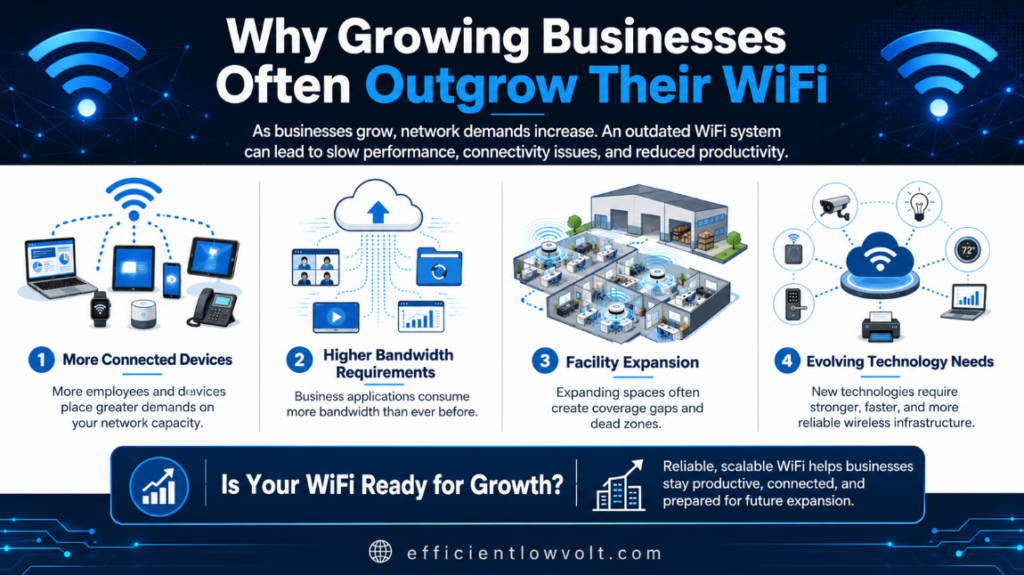
A wireless network that worked perfectly a few years ago may no longer meet current demands.
1. More Connected Devices
The average workplace now supports significantly more connected devices than ever before. Employees often use laptops, smartphones, tablets, wireless peripherals, and specialized business equipment simultaneously.
As device density increases, network congestion becomes more common.
2. Higher Bandwidth Requirements
Applications continue to demand more bandwidth. High-definition video conferencing, cloud backups, file synchronization, and streaming services place greater demands on wireless infrastructure.
Without proper planning, network performance can degrade as bandwidth requirements increase.
3. Facility Expansion
As businesses grow, they often expand into larger offices, additional floors, warehouses, or multiple locations.
Expanding physical space without updating wireless infrastructure can lead to coverage gaps, weak signal areas, and inconsistent performance.
4. Evolving Technology Needs
Modern businesses are increasingly adopting smart devices, IoT technologies, automation systems, and cloud-based solutions.
These technologies depend on strong wireless connectivity and can quickly expose weaknesses in an aging network.
Warning Signs Your WiFi Is Costing Your Business Money
Many organizations experience performance issues without realizing the underlying cause.
Here are some common warning signs that your WiFi may be affecting productivity and revenue:
- Frequent Connectivity Complaints: If employees regularly report slow internet speeds or dropped connections, it may indicate a larger network issue.
- Lag During Video Calls: Consistent video conferencing problems often point to insufficient wireless capacity or poor network design.
- Slow Cloud Applications: Cloud-based software should operate smoothly under normal conditions. Persistent delays may signal wireless performance limitations.
- Dead Zones Throughout the Facility: Areas with weak or nonexistent coverage can create productivity barriers and disrupt workflows.
- Growing Number of Connected Devices: As device counts increase, network performance may deteriorate if the infrastructure is not designed to support additional demand.
- Recurring IT Support Requests: Frequent connectivity-related support tickets often indicate that the wireless network requires optimization or replacement.
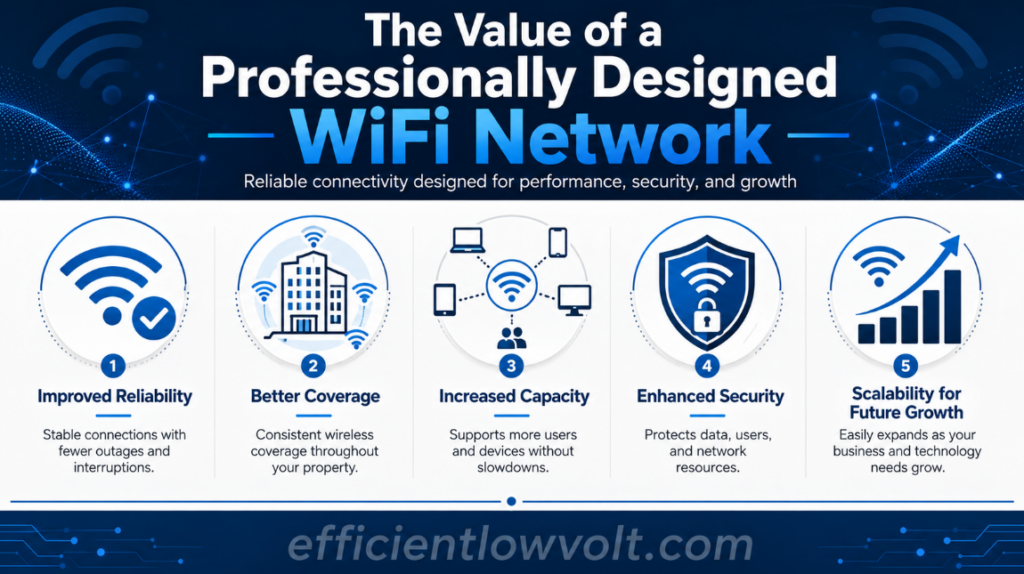
The Value of a Professionally Designed WiFi Network
A properly designed wireless network provides more than internet access. It serves as the foundation for modern business operations.
1. Improved Reliability
Professional network design helps ensure consistent connectivity throughout the facility, reducing downtime and performance disruptions.
2. Better Coverage
Strategic access point placement minimizes dead zones and delivers more uniform coverage across the environment.
3. Increased Capacity
Modern WiFi systems can support large numbers of devices while maintaining strong performance and stability.
4. Enhanced Security
Professionally configured networks include advanced security measures that help protect sensitive business information and reduce cybersecurity risks.
5. Scalability for Future Growth
A well-designed wireless infrastructure can adapt to changing business needs, allowing organizations to expand without sacrificing performance.
Is Your WiFi Costing You More Than You Realize?
Poor WiFi can have a much greater impact on your organization than many business owners realize. From reduced employee productivity and customer dissatisfaction to operational inefficiencies and lost revenue opportunities, wireless connectivity problems can quietly affect nearly every aspect of your business. Investing in reliable WiFi infrastructure is not simply a technology decision it’s a strategic business decision that supports growth, efficiency, and long-term success.
How Efficient LowVolt Solutions Helps Businesses Stay Connected
At Efficient LowVolt Solutions, we understand that every organization has unique connectivity requirements. Our team designs and deploys customized wireless networks that provide reliable coverage, strong performance, and long-term scalability.
We begin by evaluating your environment, identifying potential challenges, and developing a solution tailored to your operational goals. Whether you need WiFi for a small office, a multi-floor commercial facility, a healthcare environment, or a growing enterprise, we deliver solutions engineered to support your success.
Our services include professional WiFi design, installation, optimization, and performance enhancement. By leveraging modern wireless technologies and industry best practices, we help eliminate dead zones, improve reliability, and create seamless connectivity experiences for employees, customers, and visitors.