

If you???re planning a new building, renovating an existing space, or upgrading an older property, low voltage systems are often overlooked???until something stops working. Suddenly, issues become urgent: security cameras fail at critical moments, Wi-Fi coverage drops in key areas, fire alarm panels trigger unexpected faults, or a ???smart??? setup feels unreliable and disconnected.
What many property owners don???t realize is that low voltage systems form the backbone of how modern buildings operate. They power communication, security, and automation across both commercial and residential spaces. When properly designed and installed, they run quietly in the background and perform exactly as expected. When poorly executed, they lead to ongoing disruptions, costly fixes, and operational inefficiencies.
In this guide, you???ll walk away with a practical, no-nonsense understanding of:
- What low voltage systems actually are (without the technical overload)
- The main types used in commercial and residential properties
- How they???re designed, installed, and kept compliant
- Common mistakes that lead to long-term issues
- How to plan and prioritize your own low voltage strategy, whether for business or home use
What Are Low Voltage Systems?
At its simplest, a??low voltage system is any electrical system that operates at a lower voltage than standard power outlets and equipment, and is typically used for communication, control, safety, and data rather than heavy power loads. Many building and safety codes define??low voltage systems as those using 50 volts or less, with common levels like 12 V, 24 V, and 48 V for control, signaling, and telecom.
In practical terms, low voltage systems are what power and connect things like:
- Network and structured cabling
- Security cameras and access control
- Fire alarms and life safety systems
- Intercoms, audio, and paging
- Building automation and HVAC controls
- Smart home devices and sensors
They???re safer to work with than high???voltage power, but they still fall under strict codes and standards, especially when they relate to fire, security, and life safety.
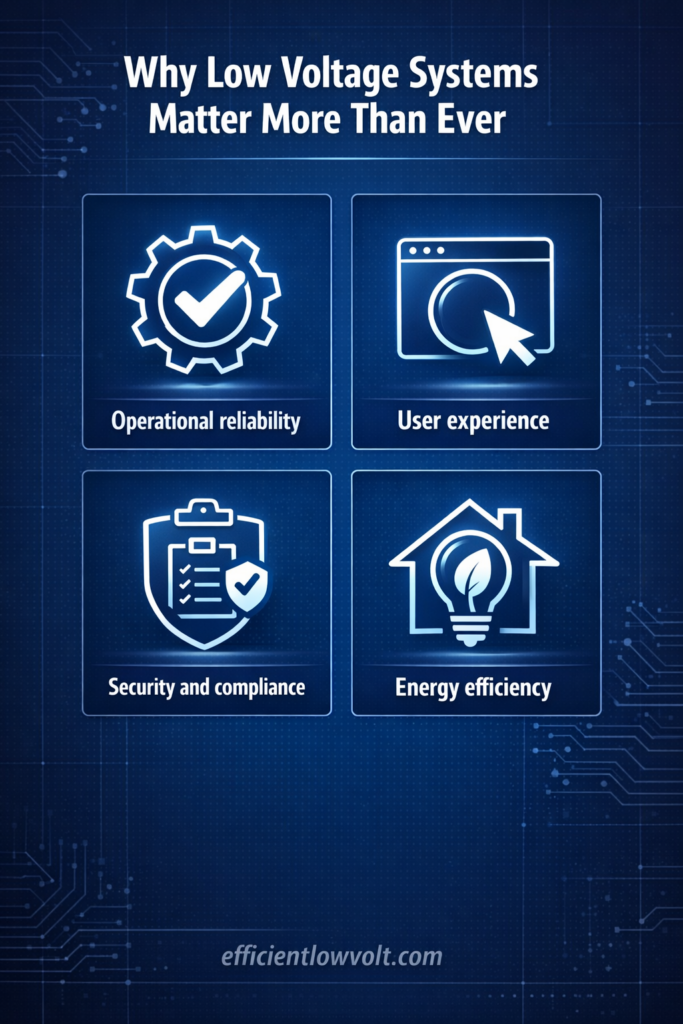
Why Low Voltage Systems Matter More Than Ever
In my experience, the turning point for most building owners comes when they realize their ???electrician handled the wires??? isn???t the same as having a well-planned, low-voltage infrastructure. As buildings get smarter and more connected, low voltage systems now drive:
- Operational reliability ??? networks, alarms, access, and controls must be up 24/7 for business continuity and safety.
- User experience ??? from Wi???Fi coverage to smart lighting scenes to intercoms at the door, occupants feel the quality of these systems daily.
- Security and compliance ??? regulated industries, multi???tenant offices, and residential complexes rely on integrated security and life safety systems.
- Energy efficiency ??? sensors and automation for lighting, HVAC, and energy management often live entirely on low voltage networks.
This is usually overlooked, but it matters: low voltage is no longer ???nice to have.??? It???s part of the core infrastructure, right alongside electrical panels and plumbing.
Core Types of Low Voltage Systems
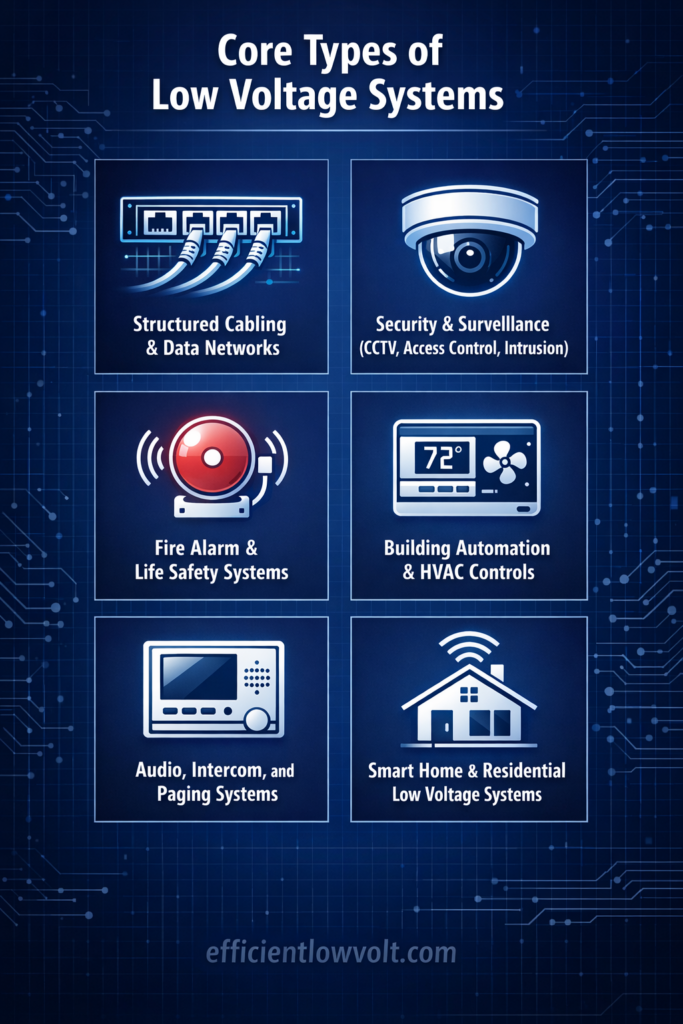
Let???s break down the main low voltage systems you???ll encounter in commercial and residential projects.
1. Structured Cabling & Data Networks
Structured cabling is the organized, standards???based approach to running data and telecom cabling throughout a building. Instead of random cables pulled as needed, you get a planned, labeled, and scalable system that supports:
- Internet and LAN connectivity
- VoIP phones
- Wi???Fi access points
- IP cameras and access control
- Building management and IoT devices
Common cabling types include:
- Cat5e/Cat6/Cat6A for Ethernet and VoIP
- Fiber optic for backbone and high???speed links
- Coaxial for some legacy video or RF systems
Standards like ANSI/TIA???568 and related structured cabling guidelines define how these systems should be designed, installed, and tested to ensure performance and interoperability.
Real???world example: In a three???story office, structured cabling allows you to reconfigure desks, move departments, or upgrade Wi???Fi access points without tearing open walls every time you add a user.
2. Security & Surveillance (CCTV, Access Control, Intrusion)
Security and surveillance are some of the most visible low-voltage uses, especially in commercial environments, multi???family properties, and higher???end homes. Typical components include:
- CCTV/IP cameras powered via PoE over Cat6 or via coaxial in older setups
- Access control ??? card/fob readers, keypads, electric strikes, maglocks
- Intrusion alarms ??? door/window contacts, motion sensors, glass???break sensors
- NVR/DVR and control panels for centralized monitoring
These systems depend heavily on clean, stable low voltage power and reliable data paths. Signal integrity, proper cable type, and separation from electrical noise sources are critical.
Practical scenario: A retail store may combine IP cameras, door sensors, and access control so that a forced???entry event triggers an alarm, records from all relevant cameras, and logs which access credentials were last used.
3. Fire Alarm & Life Safety Systems
Fire alarm and life safety systems are heavily regulated and mission???critical. They rely on low voltage circuits to connect:
- Smoke and heat detectors
- Pull stations
- Fire alarm control panels (FACP)
- Notification devices like horns, strobes, and speakers
In many regions, these systems must comply with the National Electrical Code (NEC) and standards from the National Fire Protection Association (NFPA), such as NFPA 70 and related fire alarm standards. Low voltage fire alarm circuits often use specialized alarm cables, communication wires, and control wiring that are fire???rated and installed with strict routing and protection requirements.
Here???s where things often go wrong: treating fire alarm cabling like ???just another low voltage run??? and ignoring routing, separation, or rating requirements can lead to failed inspections, forced rework, or systems that may not perform correctly in an emergency.
4. Building Automation & HVAC Controls
Building automation systems (BAS) and HVAC controls use low voltage networks to connect controllers, sensors, dampers, valves, and user interfaces. These systems coordinate:
- Temperature control and zoning
- Ventilation and air quality monitoring
- Lighting control and daylight harvesting
- Energy metering and demand response
Protocols like BACnet, Modbus, DALI, or proprietary networks ride on top of low voltage cabling to tie everything together. In a commercial building, this may integrate with a central Building Management System (BMS) so facilities staff can monitor everything from a single dashboard.
Example: Occupancy sensors in offices can automatically dim or switch off lights and adjust HVAC setpoints in unoccupied rooms, significantly lowering energy usage over time.
5. Audio, Intercom, and Paging Systems
Audio and paging systems are common in:
- Schools and campuses
- Warehouses and industrial sites
- Retail stores and hospitality
- Apartment complexes and gated communities
They use low voltage cabling for:
- Speakers and amplifiers
- Intercom door stations
- Emergency paging and mass notification
- Background music distribution
Here, cable selection (gauge, type, shielding) and proper zoning/layout impact sound quality, volume consistency, and reliability. In residential environments, this overlaps with whole???home audio and smart doorbells.
6. Smart Home & Residential Low Voltage Systems
On the residential side, low voltage systems show up as:
- Home networking and Wi???Fi
- Smart thermostats and HVAC control
- Doorbell cameras and smart locks
- Security systems and cameras
- Multi???room audio and home theater
- Irrigation and landscape lighting control
While the scale is smaller than commercial, the expectations are often higher???homeowners expect everything to be seamless and app???driven. Under the hood, it???s still low voltage cabling, power supplies, and control wiring doing the heavy lifting.
Key Design Principles for Low Voltage Systems
Design is where long-term reliability is won or lost in low voltage systems. The temptation is to ???just pull cables where we need them,??? but that approach often leads to a disorganized setup that???s costly to maintain and difficult to upgrade over time.
Plan Around Function and Growth
A good low voltage design starts with:
- What functions the building needs now (network, security, fire, automation).
- What???s likely to be added in the next 3???10 years.
- Where the core spaces are: telecom rooms, IDFs/MDFs, equipment racks.
Designers typically calculate load capacity (how many devices, how much power, what bandwidth) and ensure the system can support that with headroom for growth. For data cabling, that often means extra drops and spare conduits; for security and fire alarm, it may mean leaving panel capacity and cable pathways for future devices.
Follow Codes, Standards, and Manufacturer Specs
Low voltage doesn???t mean ???no rules.??? You still need to comply with:
- Electrical codes (like NEC in the U.S.)
- Fire and life safety standards (NFPA)
- Structured cabling and telecom standards (TIA???568, etc.)
- Local building codes and AHJ (Authority Having Jurisdiction) requirements
These dictate things like:
- Cable types and ratings (plenum, riser, fire alarm rated, etc.)
- Separation from power circuits to avoid interference
- Support and routing (trays, conduits, fill limits, bend radius)
- Grounding, bonding, and surge protection
Codes are enforced via permits and inspections, and ignoring them can mean delays, rework, fines, or systems that legally cannot be used.
Prioritize Cable Management, Labeling, and Documentation
This is usually overlooked, but it matters a lot for long???term maintainability:
- Clean routing in trays and conduits, no overfilled bundles.
- Proper bend radius and strain relief to avoid cable damage.
- Labeling cables, patch panels, jacks, devices, and circuits.
- As???built documentation showing pathways and terminations.
Standards like TIA???568 and related guidelines directly address these practices because they reduce the risk of failures, make troubleshooting faster, and enable safer work in the future.
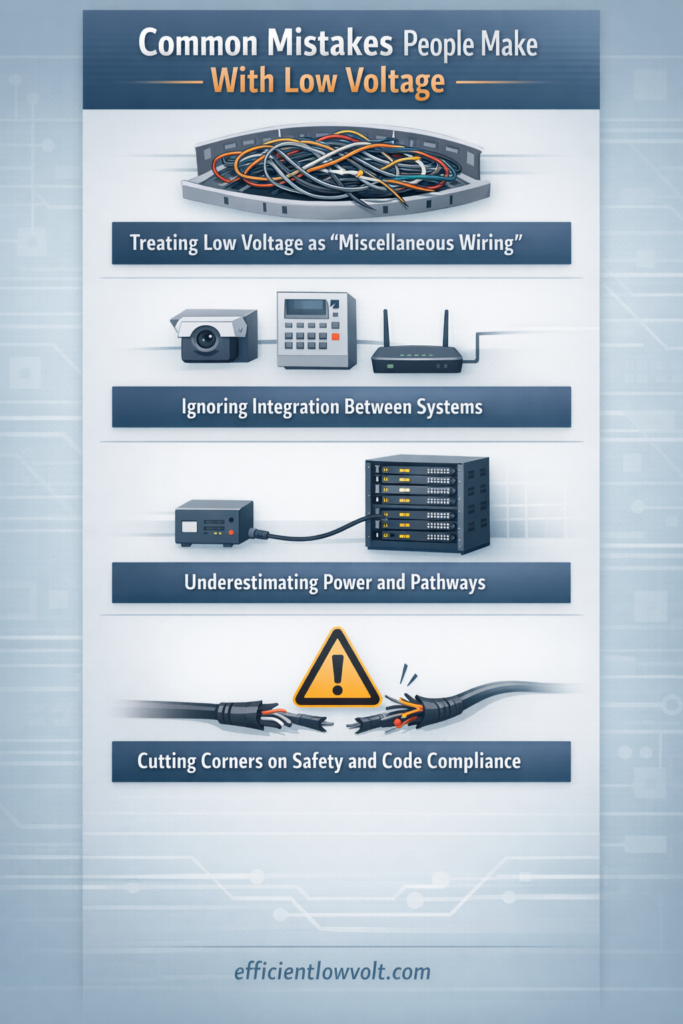
Common Mistakes People Make With Low Voltage
Here???s where things often go wrong, especially when low voltage systems are treated as an afterthought rather than a critical part of the overall infrastructure.
1. Treating Low Voltage as ???Miscellaneous Wiring???
Homeowners and even some commercial clients assume that as long as someone ???runs the wires,??? they???re fine. The result:
- Random cable types mixed together
- No labeling or documentation
- No attention to interference or separation
- No thought about future changes
The impact is felt later, when you try to expand, troubleshoot, or pass inspection. Often, the only fix is ripping out and redoing sections of the system.
2. Ignoring Integration Between Systems
Modern buildings need systems to talk to each other:
- Fire alarms triggering door releases and elevator controls
- Access control tied to video verification
- BAS reacting to occupancy data from security or Wi???Fi analytics
If each system is designed in a vacuum, you end up with duplicate cabling, incompatible protocols, and missed opportunities for automation and efficiency.
3. Underestimating Power and Pathways
A common mistake in both commercial and residential projects is under???sizing:
- Pathways (not enough conduits or tray capacity)
- Rack space in closets or telecom rooms
- Power capacity for PoE switches and controllers
As more devices get powered via PoE or low voltage (cameras, access, Wi???Fi, IoT), switches get loaded and cables get crowded. If you didn???t plan for power and space, upgrades become painful.
4. Cutting Corners on Safety and Code Compliance
In fire alarm installations and life safety circuits, cutting corners on cable types, routing, or separation is not just a code issue???it???s a real safety risk. Non???compliant installs may:
- Fail during an actual incident
- Fail inspection and require full rework
- Expose the owner to liability if something goes wrong
The short???term savings rarely justify that risk.
Myths and Misconceptions About Low Voltage Systems
Let???s address a few myths that cause real???world problems.
Myth 1: ???Low Voltage Is Always Safe and Simple???
Reality: While low voltage is generally safer than high???voltage power circuits, it can still cause:
- Equipment damage (from faults, surges, or incorrect wiring)
- Fire risks (from overloaded or damaged cables, poor routing)
- System failures at critical moments (especially fire alarm and security)
It still demands proper design, installation, and testing. ???Safe??? doesn???t mean ???carefree.???
Myth 2: ???Any Electrician Can Handle All Low Voltage Work???
Many electricians are capable of low voltage work, but not all specialize in:
- Complex-structured cabling design
- Enterprise networking and PoE planning
- Integrated security or fire alarm systems
- Building automation and protocol integration
In my experience, the best results come when a qualified low voltage contractor or integrator works alongside the electrical contractor, each focusing on their strengths.
Myth 3: ???Wireless Makes Cabling Obsolete???
Wireless is everywhere, but it still rides on top of wired infrastructure:
- Wi???Fi access points need cabling and PoE.
- Wireless cameras are rarely truly wireless (they still need power).
- Reliability and bandwidth at scale still come from wired backbones.
Going ???all wireless??? usually means you???re quietly accepting lower reliability and higher interference, especially in commercial spaces.
Myth 4: ???We???ll Run Extra Cables Later If Needed???
Later is almost always more expensive. Once walls are closed and ceilings are finished, adding pathways or new high???density cabling can mean disruptive and costly work. Planning extra capacity up front???especially in conduits and risers???typically costs far less than retrofits.
Commercial vs Residential Low Voltage: Key Differences
Both commercial and residential properties use similar technologies, but the scale, complexity, and regulatory environment differ significantly.
How They Compare
| Aspect | Commercial Buildings | Residential Properties |
| Scale & Device Count | High density: many users, cameras, access points, controllers. | Lower density; fewer endpoints overall. |
| Regulatory Pressure | Strict codes, inspections, and compliance (NEC, NFPA, AHJ). | Codes still apply, but oversight is usually lighter. |
| Systems Integration | Strong need for integrated security, BAS, fire, IT. | Often fragmented (separate apps, devices). |
| Network & Cabling Standards | Formal structured cabling per TIA???568, documented and tested. | Mix of structured and ad???hoc cabling, often ISP???driven. |
| Upgrade Cycles | Planned refresh cycles and capital projects. | Incremental upgrades driven by homeowner needs. |
| Criticality | Direct impact on operations, safety, liability. | Impacts comfort, security, resale value. |
For businesses, low voltage is part of operational risk and compliance. For homeowners, it???s a mix of convenience, safety, and future???proofing the property.
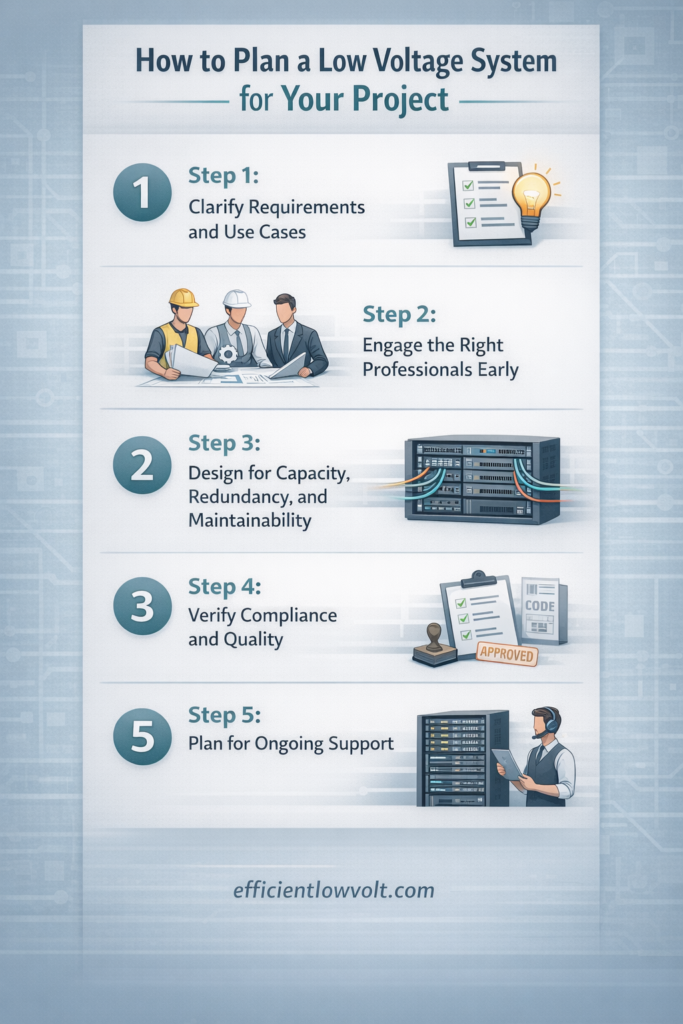
How to Plan a Low Voltage System for Your Project
Whether you???re a company or a homeowner, the planning approach shares some core steps.
Step 1: Clarify Requirements and Use Cases
Start with outcomes, not products. Ask:
- What must this building do day???to???day?
- Who needs to be connected, monitored, or controlled?
- What regulations apply (fire, security, industry standards)?
- How might this change in the next 5???10 years?
Document requirements for:
- Network and internet
- Security and access
- Fire and life safety
- Automation and energy management
- Audio/intercom and special systems (e.g., nurse call, parking access)
Step 2: Engage the Right Professionals Early
Bring in:
- A low voltage designer or integrator familiar with your building type
- Your IT/network team (in???house or outsourced)
- Relevant specialty contractors (fire alarm, security, AV)
What most people don???t realize is that low voltage decisions affect architectural layouts (closets, risers), electrical design (circuits for PoE switches, power supplies), and even mechanical design (space for racks and cooling).
Step 3: Design for Capacity, Redundancy, and Maintainability
Good designs consider:
- Extra cable runs and ports in key locations
- Spare rack units and switch ports
- Redundant paths for critical systems (e.g., fire alarm, main network)
- Clear labeling and documentation from day one
It???s not about overbuilding everything; it???s about thoughtful, strategic headroom where change is most likely.
Step 4: Verify Compliance and Quality
During and after installation, insist on:
- Proper test reports for cabling (per TIA standards)
- Fire alarm and life safety testing as required by code
- Documentation of cable paths, panel schedules, IP schemes (if in scope)
- Confirmed adherence to NEC, NFPA, and local codes
Cutting this step is a false economy. Problems discovered after occupancy are always harder to fix.
Step 5: Plan for Ongoing Support
Even the best low voltage system isn???t ???set and forget.??? You???ll need:
- A process for moves, adds, and changes
- Vendor or in???house support for troubleshooting
- Regular reviews as technology and needs evolve
For businesses, this typically ties into IT and facilities maintenance. For homeowners, it may mean staying with the same integrator or ensuring documentation is left for future upgrades.
When Best Practices Don???t Fully Apply
Real projects are messy. Budget, timeline, and existing constraints can force trade???offs.
A few examples:
- Existing buildings with limited pathways ??? You may need a hybrid of wired and wireless, or creative use of existing conduits, while planning long???term improvements.
- Phased rollouts ??? In multi???stage renovations, you might design the ???end state??? low voltage plan but implement it in phases, making sure each phase doesn???t block future work.
- Small residential projects ??? It might not be cost???effective to apply full commercial???grade structured cabling, but you can still use the principles: extra conduits, central wiring locations, and good labeling.
The key is to know what the ideal looks like, then make conscious trade???offs instead of accidental compromises.
Conclusion: Bringing It All Together
Low voltage systems are no longer a secondary feature???they are the backbone that supports safety, security, communication, and overall efficiency in any modern building. When properly designed and installed, they operate seamlessly in the background, enabling everything from reliable internet connectivity to secure access control and life safety systems. However, when treated as an afterthought, they quickly become a source of costly disruptions, compliance issues, and ongoing frustration. Taking the time to audit your current setup, plan for future needs, address critical risks, and maintain proper documentation ensures your infrastructure remains reliable, scalable, and easy to manage over time.
If you???re ready to move from uncertainty to a system you can depend on, now is the time to take action. Efficient Low Voltage Solutions & System Integration specializes in structured cabling and advanced security and surveillance systems, including CCTV and access control, designed to keep your property connected and protected. Whether you’re upgrading an existing setup or starting from scratch, our team can help you build a streamlined, future-ready solution tailored to your needs. Reach out today to start building a more reliable and secure foundation for your business or home.