Why Cable Selection Matters in Commercial Network Design
When evaluating Cat6 vs Cat6A vs Fiber Optic for modern commercial facilities, physical layer cabling forms the essential foundation of all digital communications
In modern commercial enterprise environments, corporate offices, healthcare complexes, industrial manufacturing plants, and logistics distribution centers, physical layer cabling forms the essential foundation of all digital communications. From enterprise IP surveillance cameras and high-density Wi-Fi 6E/7 wireless access points to VoIP telephone networks, building automation controllers, and high-speed data center server connections, every network packet travels across structured cabling infrastructure.
Selecting the appropriate physical cabling media between Category 6 (Cat6), Category 6 Augmented (Cat6A), multimode optical fiber, and single-mode optical fiber is one of the most consequential decisions made during commercial facility design. Unlike network switches, routers, or access points which can be unbolted and upgraded in a server rack within minutes re-cabling a commercial building involves significant physical labor, wall access, ceiling conduit routing, plenum pathway management, and operational workplace disruption. Making the correct physical layer media selection during the architectural planning stage ensures that a commercial facility supports current bandwidth demands, high-wattage Power over Ethernet (PoE), and future enterprise network expansions without requiring premature, costly infrastructure retrofits.
—
Cat6 vs Cat6A: What Is the Difference?
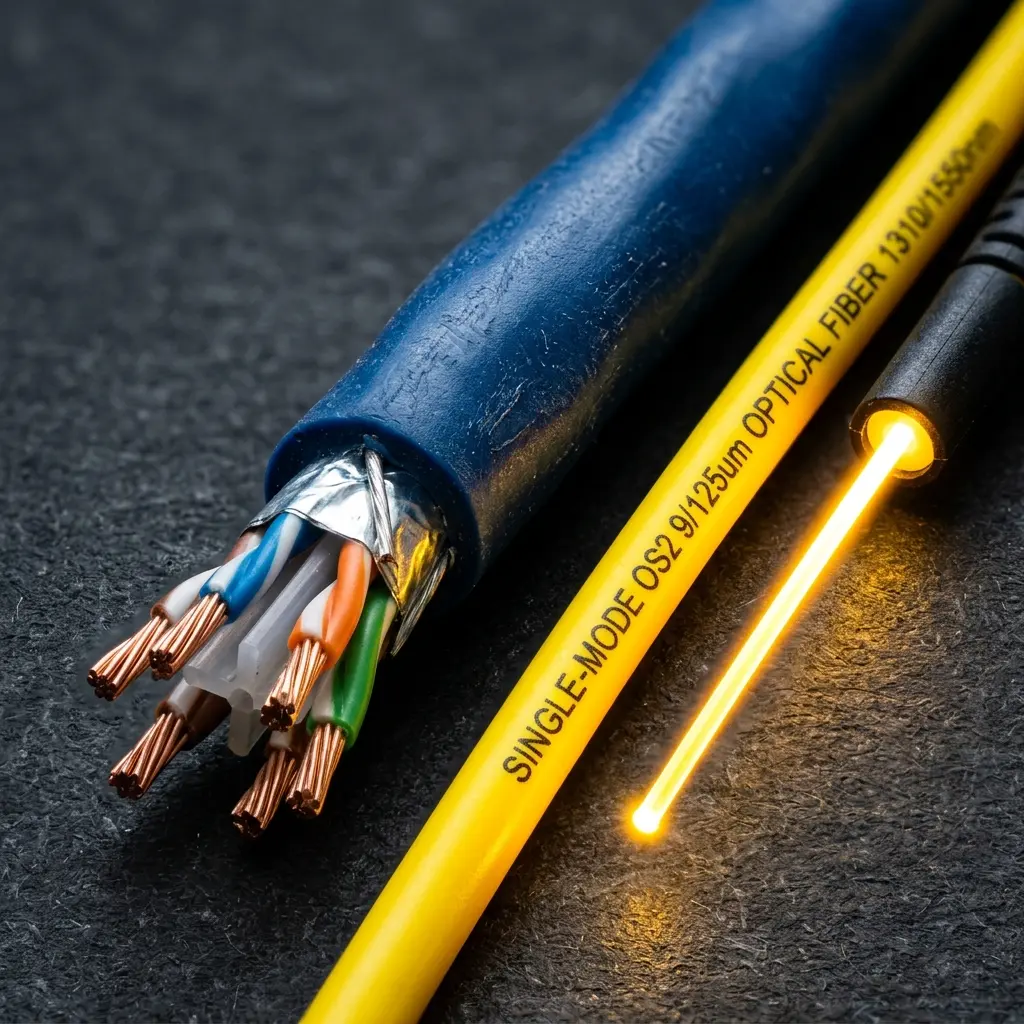
When comparing Cat6 vs Cat6A vs Fiber Optic, Copper twisted-pair cabling remains the primary choice for horizontal workstation drops connecting end-user devices, desktop computers, IP phones, and wireless endpoints to telecommunications rooms. However, substantial technical differences separate Cat6 and Cat6A media across frequency, bandwidth, attenuation, and physical construction.
Bandwidth and Frequency
The fundamental technical distinction between Category 6 and Category 6 Augmented cabling lies in operating frequency and raw data transmission bandwidth:
1Gbps and 10Gbps Deployment Considerations
While Cat6 can support 10GBASE-T data speeds under favorable conditions over short distances, its real-world 10Gbps transmission is strictly limited to channel lengths between 37 and 55 meters (121 to 180 feet), depending heavily on external electromagnetic noise and bundle density. Beyond 55 meters, high-frequency signal attenuation prevents reliable 10Gbps packet delivery on Cat6. Conversely, Cat6A was engineered specifically to deliver sustained 10Gbps performance across the entire 100-meter (328-foot) TIA channel distance limit???comprising 90 meters of solid copper permanent link cable plus 10 meters of stranded copper patch cords.
Distance and Installation Conditions
Both Cat6 and Cat6A conform to the standard 100-meter maximum channel length restriction for horizontal Ethernet distribution. However, Cat6A physical construction presents distinct installation requirements. Cat6A conductors feature larger gauge copper wire (typically 23 AWG compared to Cat6’s 24 AWG), thicker physical jacketing insulation, and internal spline separators designed to isolate conductor pairs. As a result, Cat6A cable bundles are noticeably larger in overall outer diameter and heavier than standard Cat6 bundles. Installing Cat6A requires larger ceiling J-hooks, wider pathway cable trays, deeper backboxes, and larger conduit fill calculations to accommodate proper bend radius requirements.
Crosstalk, Shielding, and EMI
As data transmission frequencies scale up to 500 MHz for 10Gbps operation, high-frequency signals radiating from neighboring cables within dense bundles generate electromagnetic interference known as Alien Crosstalk (ANEXT).
Standard unshielded Cat6 (UTP) provides limited resistance against high-frequency ANEXT when bundled tightly in long cable runs. Cat6A mitigates crosstalk through internal design enhancements and specialized shielding configurations, including F/UTP (overall foil shield surrounding unshielded pairs) and S/FTP (individual foil shielding around each pair with an outer braided shield). Shielded Cat6A media provides exceptional immunity against severe external Electromagnetic Interference (EMI) generated by heavy electrical machinery, high-voltage conduits, transformer rooms, and fluorescent lighting ballasts.
—
When Cat6 Makes Sense for Commercial Networks
Despite the expanded performance parameters of Cat6A, standard Category 6 copper cabling remains a practical, cost-effective choice for specific commercial applications:
—
When Cat6A Is the Better Choice
Category 6A has established itself as the recommended baseline cabling specification for modern commercial new construction, enterprise office build-outs, and major infrastructure modernizations due to several key factors:
—
When Fiber Optic Is the Better Choice
While copper cabling dominates horizontal workstation distribution up to 100 meters, optical fiber is the essential physical medium for high-bandwidth, long-distance, and inter-building communications. Fiber optic cables transmit data using light pulses through glass optical cores, providing virtually unlimited bandwidth potential and 100% immunity to electrical interference.
Single-Mode Fiber for Long-Distance Links
Single-mode fiber (typically OS2 specification) features a microscopic optical core (8.3 to 9 microns) that restricts light transmission to a single optical path. This design eliminates modal dispersion, enabling single-mode fiber to transmit 10G, 40G, 100G, and 400G signals over distances spanning several miles (up to 10 kilometers or more) without needing signal repeaters. Single-mode fiber is the universal standard for campus backbones, inter-building underground conduits, and service provider demarcations.
Multimode Fiber for Building and Data-Center Applications
Multimode fiber (typically OM4 or OM5 specification) utilizes a larger optical core (50 microns), allowing multiple optical modes to propagate simultaneously. Multimode optical transceivers are generally more economical than single-mode optics for short-to-medium distance runs. Multimode fiber is widely deployed for vertical riser backbones connecting Main Distribution Frames (MDF) to Intermediate Distribution Frames (IDF) within a multi-story building (supporting 10Gbps up to 400 meters, or 40G/100G up to 100 meters), as well as high-density server rack cross-connects within data centers.
Fiber in High-EMI Environments
Because optical fiber transmits light photons rather than electrical currents, it is completely immune to electromagnetic interference (EMI), radio frequency interference (RFI), and electrical ground potential differences. Fiber optic cabling is mandatory in industrial manufacturing facilities featuring heavy arc welders, high-voltage transformers, or exterior conduit pathways subject to lightning strikes and power surges.
—
Cat6 vs Cat6A vs Fiber: Commercial Decision Matrix
When building a Cat6 vs Cat6A vs Fiber Optic decision matrix, facility managers must balance immediate equipment needs with long-term bandwidth demands
The following decision matrix outlines the key technical specifications and primary commercial use cases across physical cabling media:
| Cabling Media | Max Standard Speed | Max Distance @ Max Speed | Frequency Bandwidth | EMI Immunity | PoE Support | Primary Commercial Application |
| :— | :—: | :—: | :—: | :—: | :—: | :— |
| Cat6 (UTP) | 1 Gbps (10G @ <55m) | 100m @ 1G / ~55m @ 10G | 250 MHz | Moderate (UTP) | PoE / PoE+ (up to 30W) | Standard office desktop drops, IP phones |
| Cat6A (F/UTP) | 10 Gbps | 100m (328 feet) | 500 MHz | High (Shielded options) | High-Wattage PoE++ (up to 90W) | Wi-Fi 6/7 APs, 10G workstations, PTZ cameras |
| Multimode Fiber (OM4) | 10G / 40G / 100G | 400m @ 10G / 100m @ 40G | Optical Laser | 100% Immune | Data Only (No PoE) | Intra-building MDF-to-IDF risers, data centers |
| Single-Mode Fiber (OS2) | 100G / 400G+ | 10 km+ (Miles) | Optical Laser | 100% Immune | Data Only (No PoE) | Inter-building campus backbones, ISP demarcs |
—
PoE, Future Capacity, and Infrastructure Planning
Modern commercial building designs rely heavily on Power over Ethernet (PoE) to deliver continuous electrical power and data connectivity over a single twisted-pair copper cable. From IP surveillance cameras and access control door controllers to LED lighting fixtures and smart IoT building sensors, PoE eliminates the cost of installing localized electrical outlets at every hardware location.
However, higher PoE wattage standards???such as PoE+ (30W) and PoE++ (60W to 90W)???generate resistive heat within tightly packed cable bundles in ceiling trays. Excessive heat buildup increases signal attenuation, leading to packet retransmissions and premature cable insulation aging. Under TIA-568-2.D guidelines, Cat6A copper cabling is strongly recommended for all high-wattage PoE deployments due to its larger copper wire gauge (23 AWG) and superior thermal dissipation properties compared to standard Cat6.
—
How MDF and IDF Architecture Influences Cable Selection
Commercial network design relies on a structured hub-and-spoke topology organized around Main Distribution Frames (MDF) and Intermediate Distribution Frames (IDF):
—
Common Cable Selection Mistakes in Commercial Projects
Avoiding physical layer design errors saves substantial capital expenditure and prevents unexpected operational downtime over a facility’s operational lifecycle:
—
When to Consult a Commercial Structured Cabling Professional
Engineering an enterprise physical layer infrastructure requires balancing current operating budgets against long-term bandwidth, PoE thermal limits, and physical building constraints. Partnering with an experienced commercial low-voltage contractor ensures proper media selection, compliance with ANSI/TIA installation standards, plenum code compliance, and complete Fluke channel certification testing.
For expert technical guidance and professional implementation, explore our commercial structured cabling installation services.
—
Frequently Asked Questions
1. Is Cat6 or Cat6A better for 10Gbps Ethernet?
Category 6A is significantly better for 10Gbps Ethernet because it supports full 10Gbps speeds across complete 100-meter channel lengths under TIA standards. Standard Cat6 can only support 10Gbps over shorter distances (typically 37 to 55 meters) under favorable noise conditions.
2. When should a commercial network use fiber optic instead of copper cabling?
Fiber optic cabling should be deployed when run distances exceed the 100-meter copper limit, when connecting separate buildings across a campus, when linking MDF rooms to floor-level IDF closets, or in environments with severe electromagnetic interference (EMI).
3. What is the practical difference between Cat6 and Cat6A in commercial installations?
Cat6A delivers double the frequency bandwidth (500 MHz vs 250 MHz) and full 10Gbps performance at 100 meters. However, Cat6A cables are thicker, heavier, require wider bend radii, and demand larger conduit tray capacity during installation.
4. Is fiber optic cable better than copper in high-EMI industrial environments?
Yes. Fiber optic cables transmit data using light pulses through glass optical strands rather than electrical currents. As a result, fiber is 100% immune to electromagnetic interference (EMI), radio frequency interference (RFI), and electrical ground potential loops.
5. How does cable choice affect Power over Ethernet (PoE)?
High-wattage PoE++ (60W to 90W) generates resistive heat within bundled cables. Cat6A utilizes larger copper wire gauge (23 AWG) that dissipates heat more effectively than Cat6 (24 AWG), preventing signal attenuation and cable degradation in dense bundles.
6. Should new commercial buildings be cabled with Cat6A or fiber optics?
Modern commercial facilities utilize a hybrid cabling architecture: Cat6A copper cabling for horizontal drops from IDF closets to workstations, Wi-Fi access points, and security cameras (up to 100 meters), and optical fiber for vertical risers and MDF-to-IDF backbone links.
—
Planning the Right Commercial Network Infrastructure
Selecting the appropriate physical cabling media is foundational to establishing a resilient, high-performance commercial network. By carefully evaluating transmission distance, bandwidth requirements, PoE wattage, physical pathway constraints, and environmental noise factors, facility managers and IT leaders can deploy a structured cabling infrastructure designed to support enterprise operations reliably for years to come.
Ultimately, choosing Cat6 vs Cat6A vs Fiber Optic ensures your commercial facility is prepared for next-generation network speeds.