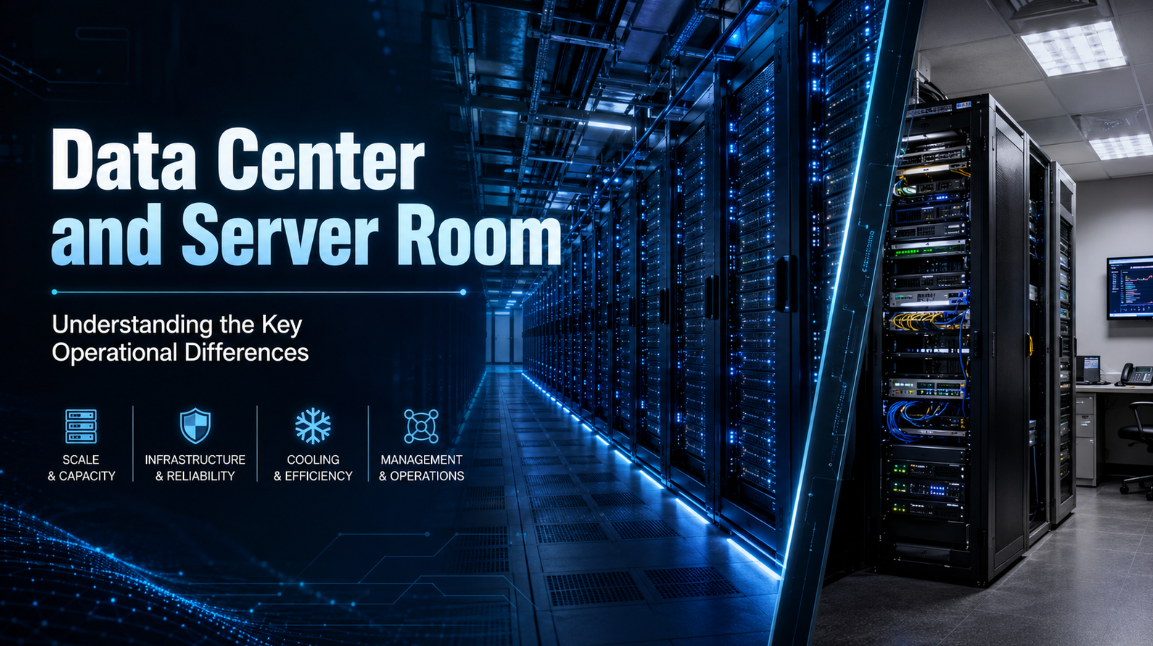
Modern businesses rely heavily on digital systems, cloud applications, and real-time data processing. Behind all of this is a physical infrastructure that keeps information flowing???most commonly a server room or a data center. While the two terms are often used interchangeably, they represent very different levels of IT infrastructure maturity, capability, and scalability.
Understanding the distinction between a data center and server room is essential for organizations planning growth, improving uptime, or upgrading their technology environment. Choosing the right setup can directly affect performance, security, and long-term operational costs.
This article breaks down the key differences in a clear, practical way so businesses can make informed infrastructure decisions.
What Is a Server Room?
A server room is a dedicated space within an office or facility that houses basic IT equipment such as servers, networking devices, and storage systems. It is typically designed for small to medium-scale operations and supports the internal needs of a single organization or location.
Unlike enterprise-grade infrastructure, server rooms are often limited by building constraints, budget, and environmental controls.
Key characteristics of a server room include:
- Located inside an office or commercial building
- Supports localized business operations
- Limited cooling and ventilation systems
- Basic power backup solutions (often UPS units)
- Minimal redundancy for hardware or network systems
- Managed by in-house IT staff or small technical teams
Server rooms are common in small businesses, startups, schools, and branch offices where computing needs are relatively straightforward. However, as organizations grow, limitations in capacity and resilience become more noticeable.
What Is a Data Center?
A data center is a purpose-built facility designed to house large-scale computing infrastructure. It supports massive amounts of data processing, storage, and network traffic, often for multiple clients or enterprise-level operations.
A modern data center is engineered for performance, redundancy, and uninterrupted uptime.
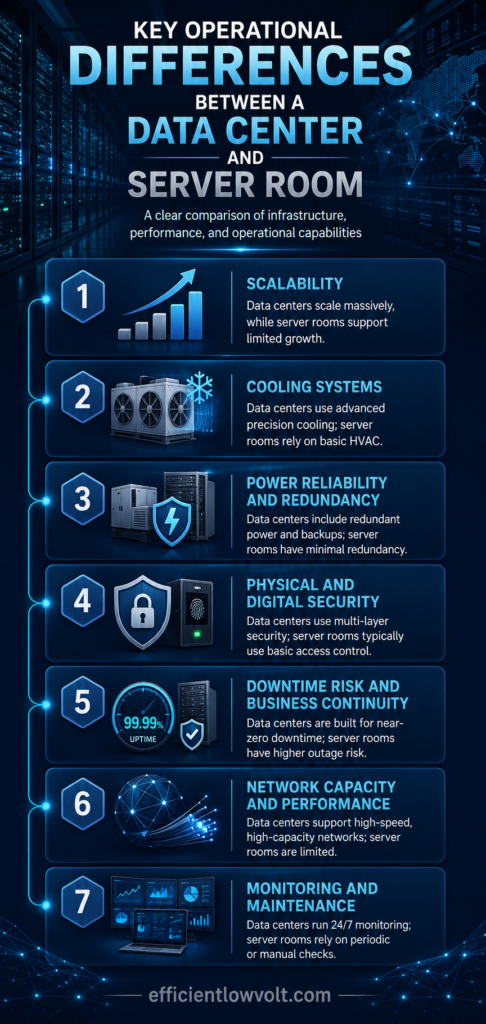
Key features include:
- Advanced cooling systems (precision HVAC and airflow design)
- Redundant power supplies and backup generators
- High-level physical and cyber security measures
- 24/7 monitoring and technical support
- Scalable infrastructure for growth and expansion
- Multiple layers of network redundancy and failover systems
Unlike a server room, a data center is built with resilience and continuous operation in mind. Even during power failures or hardware issues, systems are designed to remain online with minimal disruption.
In the comparison of a data center and server room, the data center represents a significantly more advanced and scalable environment.
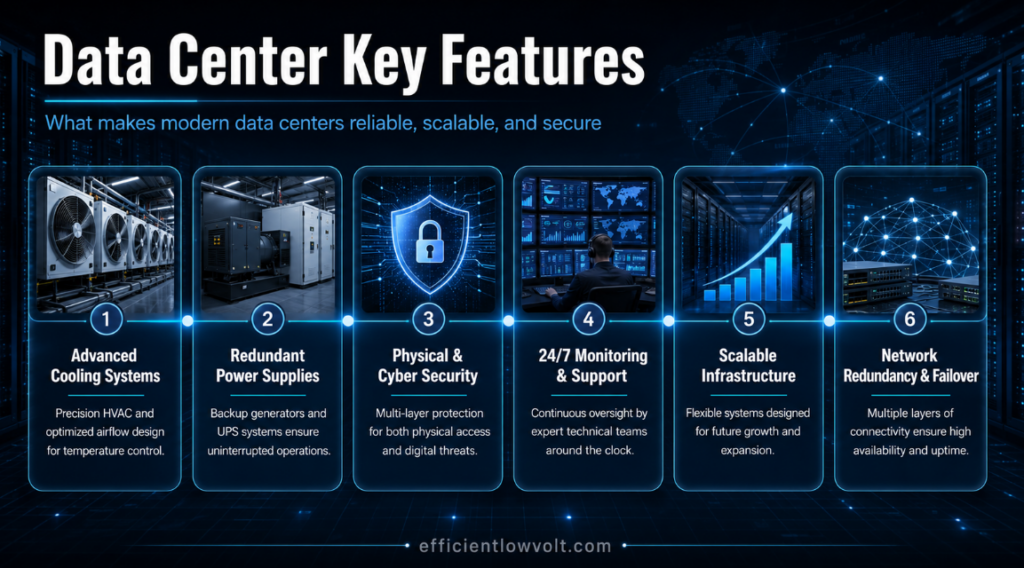
Key Operational Differences Between a Data Center and Server Room
While both environments serve IT infrastructure needs, data center and server room operational design and capabilities differ in several critical ways.
1. Scalability
Scalability refers to how easily infrastructure can grow as business needs increase.
- Server rooms: Limited physical space and power capacity restrict expansion
- Data centers: Built for modular growth and large-scale scaling
In server rooms, adding more servers often leads to overheating and power strain. Data centers, however, are designed to expand seamlessly with growing demand.
2. Cooling Systems
Heat management is one of the most important aspects of IT infrastructure.
- Server rooms:
- Standard air conditioning systems
- Uneven airflow distribution
- Higher risk of overheating under load
- Data centers:
- Precision data center cooling systems
- Hot aisle/cold aisle containment
- Constant temperature and humidity control
Poor cooling in server rooms can reduce hardware lifespan, while data centers maintain optimal environmental conditions around the clock.
3. Power Reliability and Redundancy
Power continuity is essential for preventing downtime.
- Server rooms:
- Basic UPS systems for short-term backup
- Often dependent on local power grid
- Limited redundancy options
- Data centers:
- Multiple power feeds
- Backup generators
- Redundant UPS systems (N+1 or higher configurations)
Data centers are designed to remain operational even during extended outages, while server rooms are more vulnerable to disruptions.
4. Physical and Digital Security
Security requirements differ significantly between the two environments.
- Server rooms:
- Basic locked doors or access cards
- Limited surveillance systems
- In-house access control only
- Data centers:
- Multi-layer biometric access control
- 24/7 surveillance monitoring
- Strict access logging and security protocols
In enterprise environments, protecting data is just as important as maintaining uptime, making data centers significantly more secure.
5. Downtime Risk and Business Continuity
Downtime can have serious financial and operational consequences.
- Server rooms:
- Higher risk of outages due to single points of failure
- Limited disaster recovery capabilities
- Data centers:
- Built-in redundancy for hardware and network systems
- Disaster recovery and failover systems
- High availability architecture
A key difference in the data center and server room comparison is how each handles unexpected failures. Data centers are built to minimize downtime, while server rooms often struggle with continuity during incidents.
6. Network Capacity and Performance
As businesses grow, network demands increase significantly.
- Server rooms:
- Limited bandwidth capacity
- Simple network architecture
- Potential congestion during peak usage
- Data centers:
- High-speed fiber connections
- Load balancing systems
- Optimized traffic routing and latency management
This difference becomes critical for businesses running cloud applications, remote access systems, or large databases.
7. Monitoring and Maintenance
How infrastructure is managed also varies greatly.
- Server rooms:
- Manual monitoring by IT staff
- Reactive maintenance approach
- Limited real-time analytics
- Data centers:
- Continuous 24/7 monitoring
- Automated alerts and diagnostics
- Predictive maintenance systems
Data centers use advanced monitoring tools to detect issues before they become critical failures, improving reliability.
When a Server Room Is Enough
Not every organization needs a full-scale data center. In many cases, a server room is sufficient for operational needs.
A server room is typically appropriate when:
- The business operates from a single location
- IT requirements are relatively simple
- Data storage needs are moderate
- Budget constraints limit infrastructure investment
- There is minimal need for high redundancy
For these environments, a server room provides a cost-effective and manageable solution without unnecessary complexity.
When Businesses Outgrow a Server Room
As organizations expand, the limitations of server rooms become more apparent. Transitioning to more advanced infrastructure becomes necessary when:
- Frequent system overheating occurs
- Downtime begins affecting productivity
- Data storage requirements increase rapidly
- Multiple locations need centralized access
- Cybersecurity risks become more complex
- Cloud and hybrid systems are introduced
At this stage, continuing to rely on a server room can slow down operations and increase long-term costs due to inefficiencies and system failures.
Future Trends in IT Infrastructure
The gap between server rooms and data centers continues to evolve as technology advances. Several trends are shaping the future of infrastructure design:
- Edge computing expansion
Processing data closer to end users to reduce latency - Hybrid infrastructure models
Combining on-premises systems with cloud environments - Energy-efficient cooling systems
Reducing power consumption and environmental impact - Automated infrastructure management
AI-driven monitoring and predictive maintenance tools - Modular data center design
Flexible units that can scale based on demand
These innovations are making infrastructure more adaptive, efficient, and resilient than ever before.
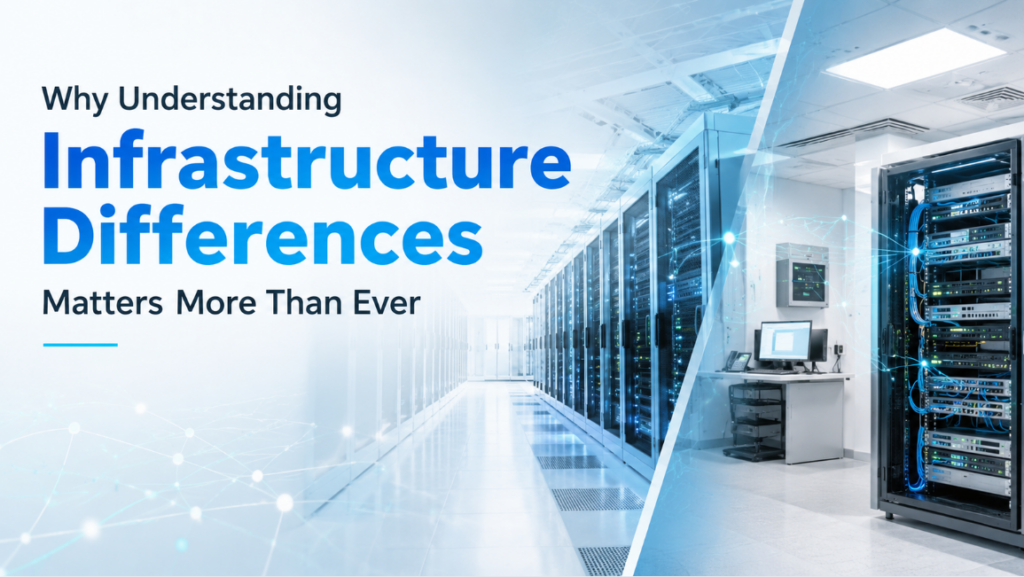
Why Understanding Infrastructure Differences Matters More Than Ever
Choosing between a server room and a data center is not just a technical decision???it is a business strategy decision. Each option supports different levels of growth, risk tolerance, and operational complexity.
The key takeaway from the comparison of a data center and server room is that infrastructure should align with business goals, not just current needs. A system that works today may become a limitation tomorrow if scalability and resilience are not considered early.
Is Your Data Center and Server Room Ready for What Comes Next?
As businesses become more dependent on digital systems, infrastructure decisions carry greater long-term impact. Understanding whether your organization should maintain a server room or transition toward more advanced infrastructure is a critical step in ensuring stability, security, and scalability.
If your current environment is struggling with performance limitations, downtime risks, or growth constraints, exploring a more resilient infrastructure approach may be the next logical step.
For organizations planning upgrades or evaluating their IT infrastructure needs, Efficient Low Voltage Solutions & System Integration can provide guidance and support in designing scalable, reliable systems built for long-term performance.