Why Fluke Network Testing & Certification Matters for Enterprise Networks
In the world of commercial IT infrastructure, assuming a cable works just because the lights blink on a switch is a dangerous and costly mistake. Modern networks transport mission-critical data, voice-over-IP (VoIP), and high-definition surveillance video. To ensure maximum uptime, every single copper and fiber run must be scientifically verified.
This is where Fluke Network Testing and Certification comes into play. It is the gold standard for validating structured cabling installations, proving that the physical layer of your network meets stringent TIA/EIA and ISO standards.
Verification vs. Qualification vs. Certification
To understand why Fluke Certification matters, it is crucial to understand the three levels of cable testing:
- Verification: The most basic test. It simply checks for continuity (are all 8 pins connected properly?) and ensures there are no shorts or open circuits. It does not measure bandwidth or performance.
- Qualification: A mid-level test. It determines if an existing cabling link can support specific network speeds (e.g., “Can this old Cat5e cable support Gigabit Ethernet?”). It is useful for troubleshooting but does not prove compliance with industry standards.
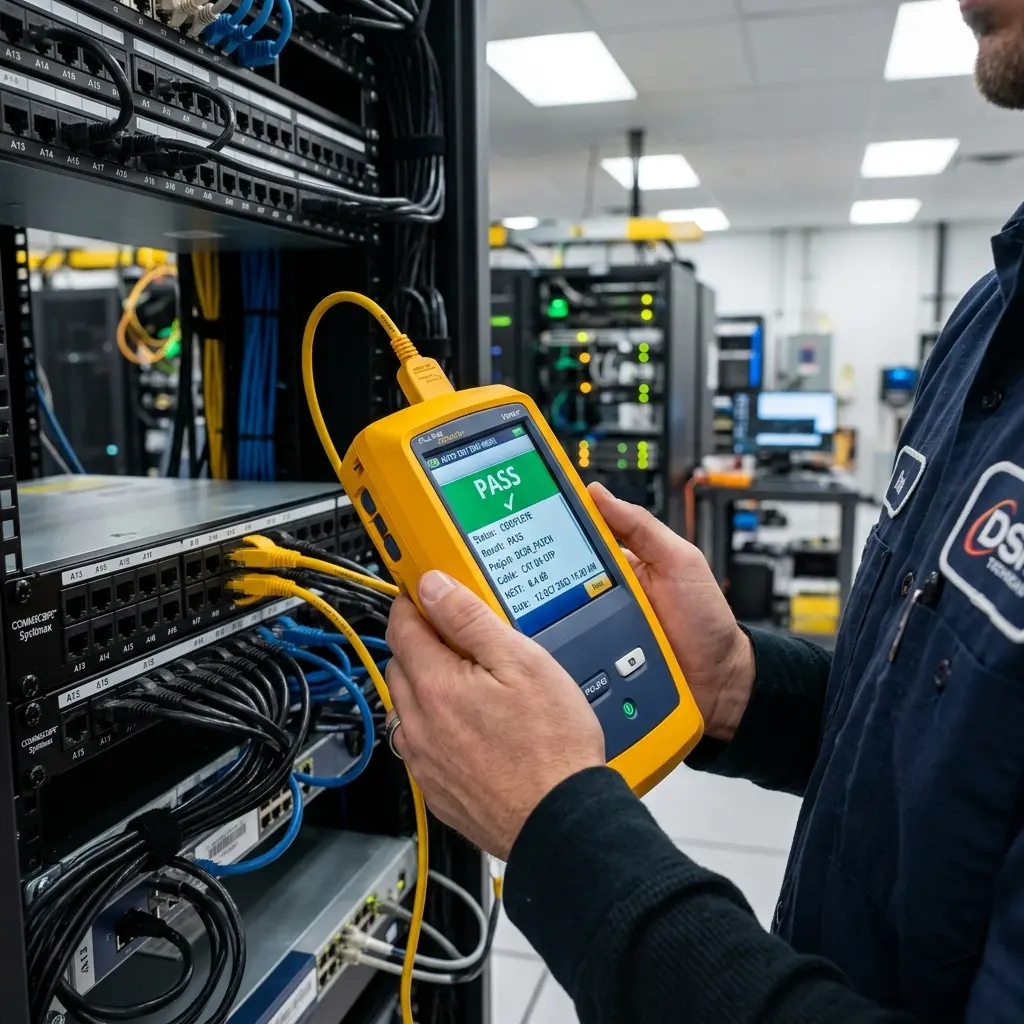
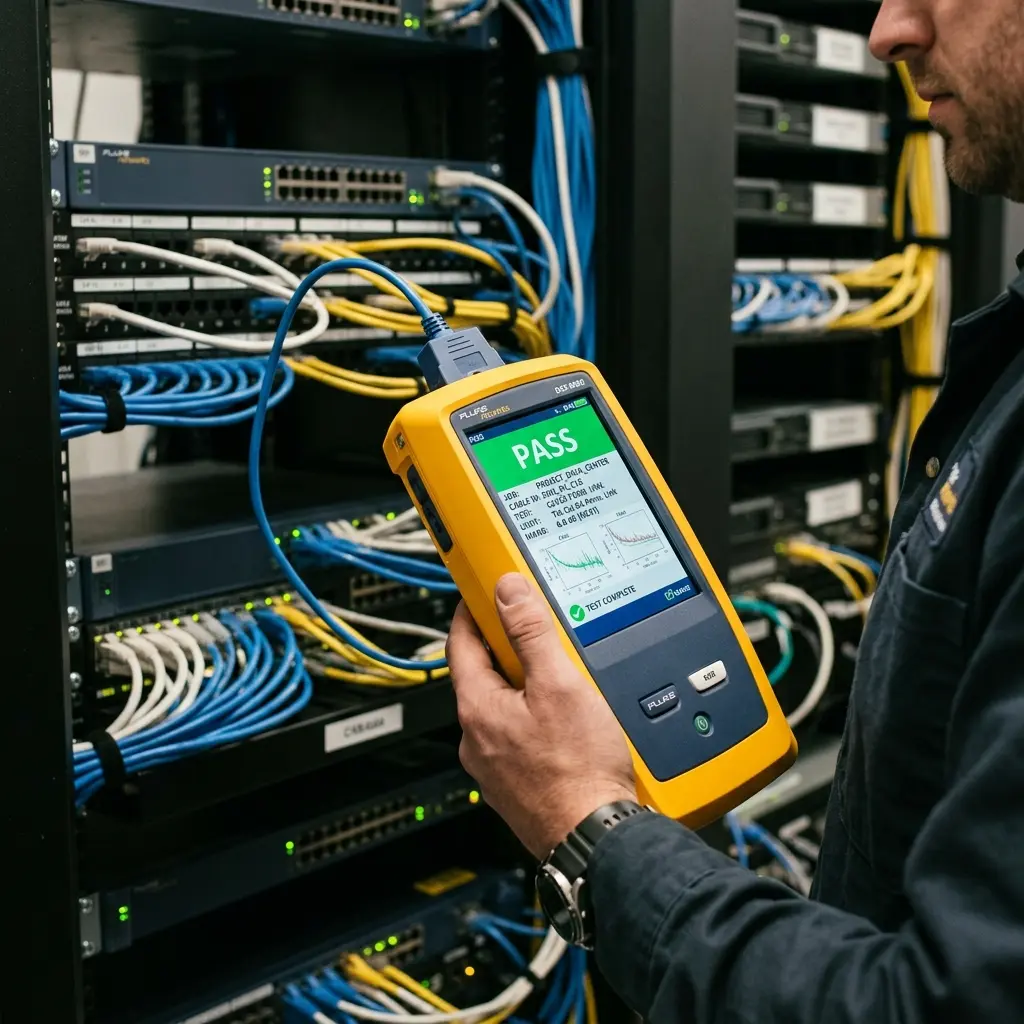
- Certification: The highest level of testing. Certification tools, like the Fluke DSX CableAnalyzer, test the cable against exact TIA/EIA standards (such as TIA-568-C.2 for Cat6A). It measures complex electrical characteristics and provides a “Pass” or “Fail” result. This is the only type of testing that major cable manufacturers will accept to issue their 20-to-25-year warranties.
What Does a Fluke Tester Actually Measure?
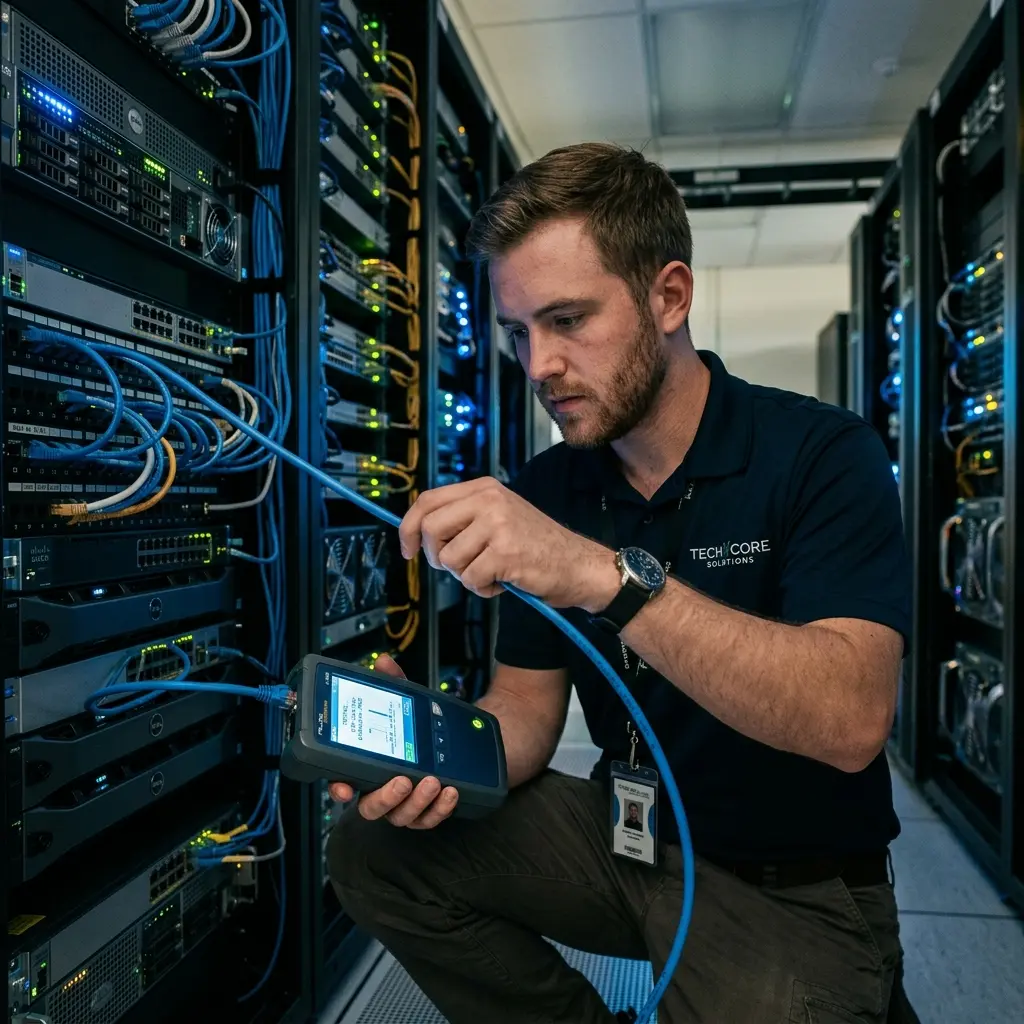
When our technicians run a Fluke Certification test, the device measures dozens of parameters. The most critical include:
- Wire Map: Confirms that all pairs are terminated correctly (usually to the T568B standard) without crossed, split, or reversed pairs.
- Length: Ensures the cable run does not exceed the maximum allowable distance (100 meters / 328 feet for Cat6/Cat6A).
- Insertion Loss (Attenuation): Measures how much signal strength is lost as data travels down the length of the cable. Excessive bending, poor termination, or long runs can cause high insertion loss.
- Near-End Crosstalk (NEXT): Measures the interference (crosstalk) between different wire pairs within the same cable at the end where the signal is transmitted. High NEXT causes data corruption and packet loss.
- Return Loss: Measures the amount of signal reflected back toward the transmitter due to impedance mismatches (often caused by poor untwisting of pairs at the termination point).
- Propagation Delay and Delay Skew: Measures the time it takes for a signal to travel from one end to the other, and the difference in arrival time between the fastest and slowest pairs. If the skew is too high, Gigabit and 10-Gigabit networks will fail to synchronize.
The Business Value of Certification
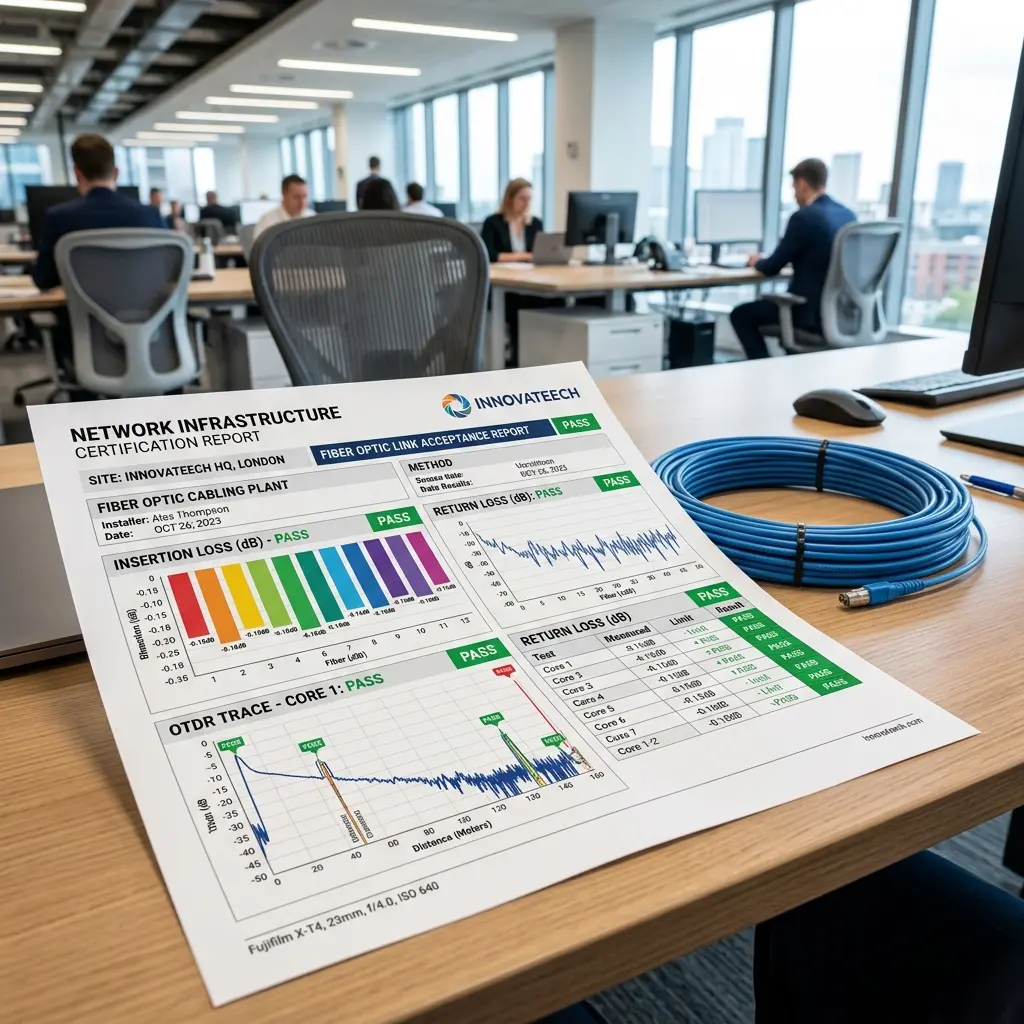
Why should facility managers and IT directors insist on Fluke Certification for their cabling projects?
1. Zero Packet Loss and Maximum Throughput
A cable that passes a basic continuity test might experience massive packet loss when subjected to 10-Gigabit traffic. Fluke testing guarantees that the cable can handle the maximum bandwidth without bottlenecks, ensuring fast application performance and clear VoIP calls.
2. Future-Proofing for PoE++
Modern networks deliver power over ethernet (PoE) to power WiFi 6 access points, LED lighting, and access control systems. Fluke testing verifies the DC loop resistance of the cable, ensuring it can safely carry high wattage (up to 90W for PoE++) without dangerous heat buildup.
3. Manufacturer Warranties
Top-tier manufacturers like CommScope, Panduit, and Belden offer 20-to-25-year system warranties. However, they require the installer to submit passing Fluke Certification reports for every single drop before issuing the warranty. Without these reports, you have no recourse if the cable fails in the future.
4. Faster Troubleshooting
When network issues arise, IT departments often waste hours blaming the switch, the router, or the software. If you have a Fluke Certification report proving the physical cable is flawless, IT can instantly rule out the cabling and focus on the actual problem, reducing downtime.
Our Commitment to Quality
At Efficient Low Voltage Solutions, we never guess. We utilize industry-leading Fluke Networks equipment to certify every copper and fiber optic installation we perform. Upon project completion, we provide our clients with a comprehensive PDF report detailing the passing metrics of every single cable drop.
Don’t trust your mission-critical data to unverified cabling. Contact us today to ensure your next IT infrastructure project is built to standard and certified for performance.