

As wireless demands continue to grow and buildings become increasingly complex, maintaining reliable indoor connectivity has become a significant challenge. Traditional outdoor cellular signals often struggle to penetrate dense construction materials such as concrete, steel, and energy-efficient glass. To address these limitations, advanced in-building wireless technologies have evolved—one of which is Active DAS (Active Distributed Antenna System).
This article explores what Active DAS is, how it works, how it differs from other Distributed Antenna System configurations, and why it plays an important role in modern wireless infrastructure design.
What Is Active DAS?
Active DAS is a type of Distributed Antenna System that uses powered electronic components and fiber optic cabling to distribute wireless signals throughout a building.
A Distributed Antenna System (DAS) in general is designed to improve indoor wireless coverage by distributing signals through multiple strategically placed antennas. Rather than relying solely on a strong signal from an outdoor tower, DAS brings the signal inside and redistributes it evenly across a structure.
Active DAS represents one configuration of DAS technology that is typically used in larger or more complex facilities where greater coverage, scalability, and signal performance are required.
How Active DAS Works
An Active Distributed Antenna System functions by capturing wireless signals from a source and distributing them throughout a building using active (powered) components.
The process typically includes:
- Signal Source – The system connects to a wireless carrier signal, base station, or repeater.
- Head-End Equipment – A centralized unit processes and manages the incoming signal.
- Fiber Optic Transport – The signal is transmitted via fiber optic cables to remote units located throughout the building.
- Remote Radio Units – These units convert the signal back to radio frequency (RF).
- Distributed Antennas – Antennas placed in ceilings, hallways, and other areas broadcast the signal locally.
Because Active DAS uses fiber optic transport and powered electronics, signal quality is maintained across long distances and multiple floors without significant degradation.
Active DAS vs Passive DAS
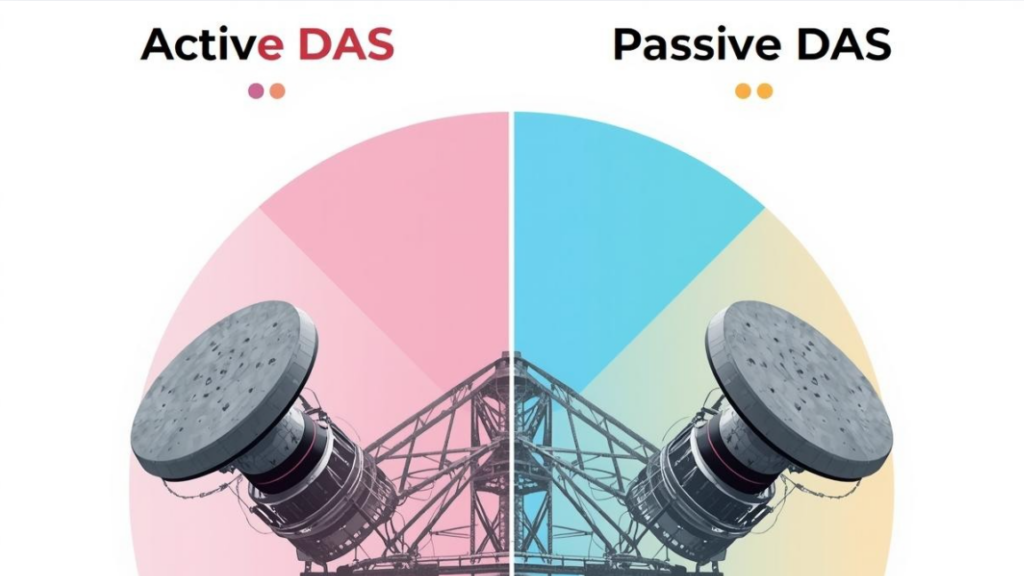
Distributed Antenna Systems are commonly categorized into two primary types: Active DAS and Passive DAS. Understanding the distinction is essential when evaluating in-building wireless solutions.
Passive DAS
Passive DAS typically uses coaxial cables, splitters, and signal boosters to distribute wireless signals. While effective in smaller facilities, signal loss can occur over longer cable runs.
Active DAS
Active DAS uses powered equipment and fiber optic cables, which minimize signal loss and allow coverage across larger areas. It is commonly used in environments where high capacity and extended reach are required.
Key differences include:
- Signal Strength Over Distance: Active DAS maintains signal quality more effectively.
- Scalability: Active systems can be expanded more easily.
- Capacity Handling: Active DAS supports higher user density.
- Infrastructure Size: Active DAS is better suited for large, multi-story facilities.
Both configurations fall under the broader umbrella of Distributed Antenna Systems, and the appropriate choice depends on building size, coverage needs, and operational requirements.
Why Active DAS Is Important in Modern Buildings
Modern buildings often experience connectivity challenges due to:
- Dense Construction Materials: Concrete, steel, and energy-efficient glass can block outdoor wireless signals, creating indoor dead zones.
- Underground Levels or Parking Structures: Basements and underground areas frequently suffer from weak or nonexistent cellular coverage.
- Large Floor Plates: Wide-open floor areas can dilute wireless signals, leaving distant corners with poor connectivity.
- High Device Usage: A growing number of mobile devices in offices, hospitals, and campuses can overload limited signal sources.
- Increased Reliance on Mobile Data: Dependence on cloud applications and mobile communication requires consistent, high-speed coverage throughout the building.
Active DAS addresses these challenges by delivering consistent wireless coverage across an entire structure.
Industries that commonly benefit from Active DAS design include:
- Healthcare Facilities: Ensures doctors, nurses, and staff maintain reliable communication for patient care and safety.
- Corporate Office Towers: Supports employees with seamless mobile and data connectivity across multiple floors.
- Warehouses and Manufacturing Plants: Enables radios, scanners, and mobile equipment to operate efficiently without signal interruptions.
- Hotels and Convention Centers: Improves guest experience by providing dependable wireless connectivity throughout large spaces.
- Educational Campuses: Maintains strong coverage across classrooms, dormitories, and common areas for students and staff.
- Large Venues and Stadiums: Handles high-density user traffic, ensuring smooth mobile communication during events.
In such environments, reliable wireless performance supports communication, safety systems, operational efficiency, and overall user experience.
Benefits of Active DAS

Although the implementation approach varies by facility, Active DAS technology offers several general advantages:
1. Expanded Coverage
Active DAS enables consistent wireless coverage across large square footage, including difficult-to-reach areas such as stairwells, elevators, and basements.
2. Signal Integrity
Fiber optic transmission helps preserve signal quality across long distances.
3. Support for Multiple Carriers
Active DAS systems can be configured to support multiple wireless carriers and frequency bands.
4. High User Capacity
Facilities with large numbers of users—such as venues or campuses—benefit from the increased capacity Active DAS can provide.
5. Scalability
As wireless needs grow, additional components can often be integrated into the existing system architecture.
Active DAS and 5G Readiness
With the expansion of LTE and 5G networks, in-building wireless infrastructure must support higher data speeds and additional frequency bands.
Active DAS systems are often designed with future network evolution in mind. Because fiber-based infrastructure and modular components are used, many Active DAS deployments can adapt to technology upgrades without requiring a complete replacement.
Future-ready infrastructure planning has become a key consideration in modern Distributed Antenna System design.
Common Wireless Challenges Addressed by Active DAS
Facilities that explore Active DAS technology often report a range of connectivity challenges, including:
- Dropped Calls Indoors: Weak signal penetration through walls and construction materials often leads to interrupted calls inside buildings.
- Slow Mobile Data Speeds: High user density and limited indoor signal strength can cause delays in data access and app performance.
- Inconsistent Coverage Between Floors: Multi-story structures frequently experience uneven signal distribution, leaving some floors with weaker connectivity.
- Radio Communication Limitations: Two-way radios and emergency communication systems may fail in areas with poor signal reception.
- Weak Signals in Elevators and Enclosed Areas: Enclosed spaces such as elevators, stairwells, and basements often become dead zones for wireless devices.
- Poor Connectivity During High-Traffic Events: Large gatherings or events can overwhelm network capacity, resulting in slow or unreliable connections.
By distributing signal sources throughout a building rather than relying solely on outdoor towers, Active DAS can mitigate many of these issues and provide consistent indoor wireless coverage.
The Role of Professional DAS Planning

Distributed Antenna Systems—whether active or passive—require careful planning and engineering. Proper site evaluation, system design, signal balancing, and compliance considerations are critical to achieving reliable performance.
Professionally designed DAS infrastructure accounts for:
- Building layout and materials
- Signal propagation characteristics
- User density and bandwidth requirements
- Carrier coordination
- Long-term scalability
Understanding how Active DAS fits within overall DAS strategy allows building owners and operators to make informed decisions about their wireless infrastructure.
Educational Resources and Guidance
As Distributed Antenna Systems continue to evolve, building owners and facility managers often seek clarity about available technologies, including Active DAS configurations.
Efficient Lowvolt Solutions provides Distributed Antenna System expertise and shares educational insights to help organizations better understand in-building wireless technologies. By staying informed about developments such as Active DAS, decision-makers can evaluate which solutions align best with their operational goals.
If you have questions about Active DAS or Distributed Antenna Systems in general, seeking professional guidance can help clarify options and next steps.