
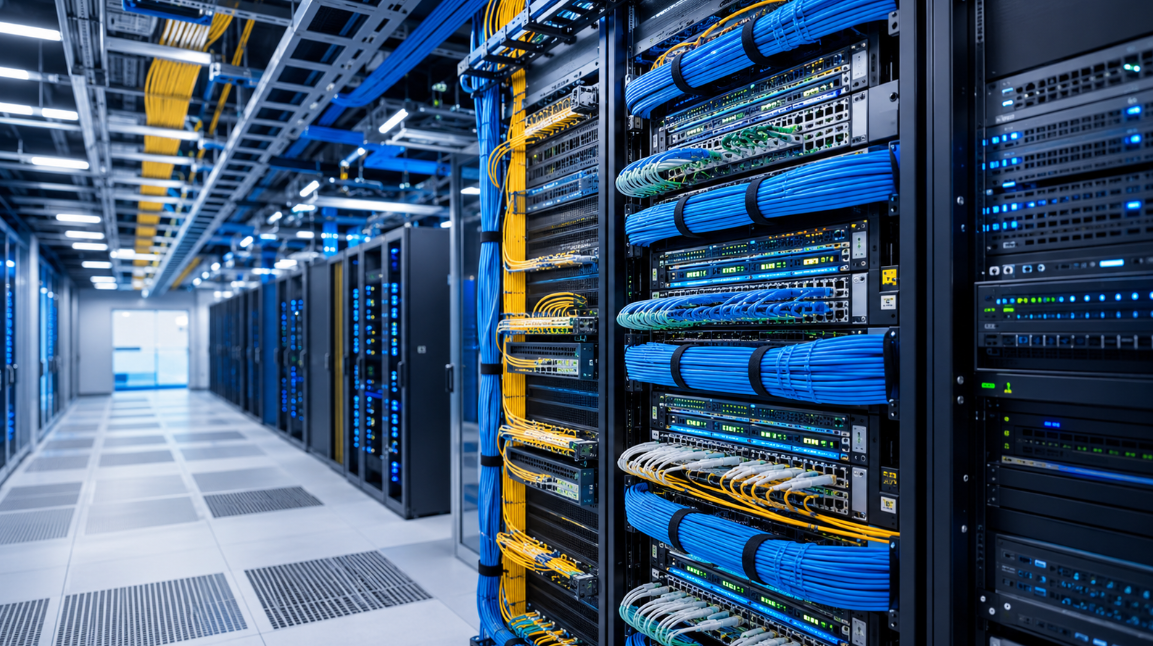
In modern digital environments, the performance of an entire IT infrastructure often depends on something that is easy to overlook: data center cabling. While servers, storage systems, and networking hardware receive most of the attention, the way cables are organized, routed, and maintained plays a critical role in uptime, efficiency, and scalability.
Poorly planned data center cabling can lead to airflow restrictions, troubleshooting delays, signal interference, and unnecessary downtime. On the other hand, a well-structured cabling system improves operational efficiency, reduces maintenance complexity, and supports future expansion without major redesigns.
As businesses continue to scale their digital operations, demand for faster, more reliable infrastructure increases. This makes cabling design not just a technical detail but a foundational element of data center success.
What is Data Center Cabling?
Data center cabling refers to the structured system of physical cables that connect servers, storage devices, networking equipment, and power systems within a data center. It includes fiber optic cables, copper Ethernet cables, and power distribution lines that together enable seamless communication and operation.
Unlike simple office networking setups, data center cabling must support:
- High-density equipment configurations
- Continuous 24/7 uptime requirements
- High-speed data transmission
- Scalable infrastructure growth
There are generally two main types:
- Copper cabling – commonly used for shorter distances and cost-effective connections
- Fiber optic cabling – used for high-speed, long-distance, and high-bandwidth requirements
A properly engineered cabling system ensures that all components work together efficiently without bottlenecks or performance loss.
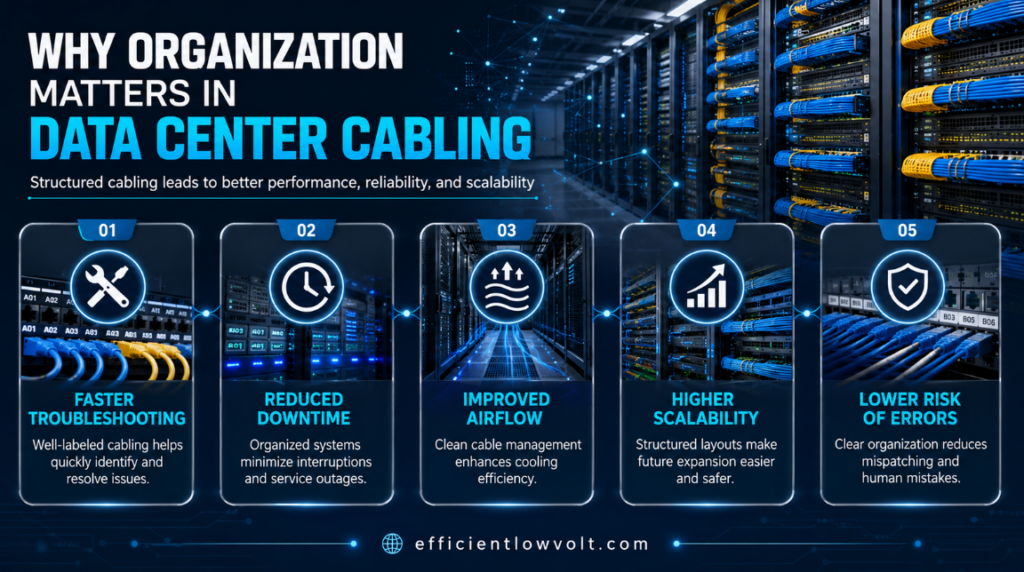
Why Organization Matters in Data Center Cabling
Organization is not just aesthetic—it directly impacts performance and reliability. Disorganized cabling can create serious operational challenges that affect the entire infrastructure.
Key reasons organization is essential:
- Faster troubleshooting – Technicians can quickly trace connections without confusion
- Reduced downtime – Clear layouts minimize repair and maintenance time
- Improved airflow – Proper routing prevents cable clutter that blocks cooling systems
- Higher scalability – Organized systems make it easier to add or remove equipment
- Lower risk of errors – Reduces accidental unplugging or misconfiguration
Well-planned data center cabling also improves safety by minimizing trip hazards and reducing strain on connectors and ports.
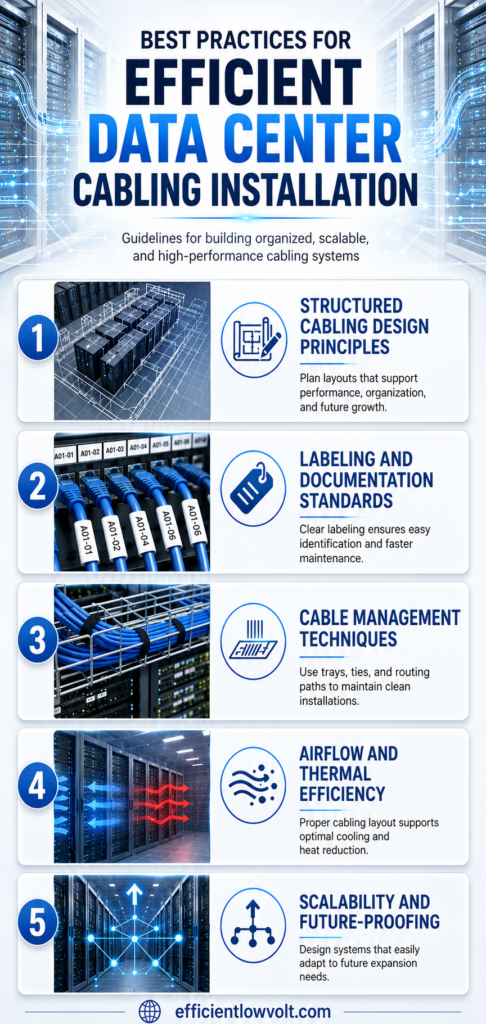
Best Practices for Efficient Data Center Cabling Installation
A well-designed cabling system follows a set of proven principles that ensure performance, scalability, and long-term reliability. These practices are essential for any modern IT environment.
1. Structured Cabling Design Principles
A structured approach ensures consistency and long-term reliability in data center cabling systems. Instead of random connections, structured cabling uses standardized layouts and hierarchical organization.
Key principles include:
- Designing with modular architecture for easy expansion
- Separating power and data lines to avoid interference
- Using standardized rack layouts across all systems
- Planning pathways before installation begins
- Maintaining consistent cable lengths where possible
A structured design reduces complexity and ensures that future upgrades do not require complete system redesigns.
2. Labeling and Documentation Standards
Clear labeling is one of the most overlooked yet critical aspects of data center cabling. Without proper documentation, even simple maintenance tasks can become time-consuming and error-prone.
Best practices include:
- Label both ends of every cable clearly
- Use consistent naming conventions across the facility
- Maintain updated digital network maps
- Document all changes immediately after implementation
- Include rack positions and port numbers in labels
Accurate documentation ensures that any technician can understand the system layout without guesswork, improving operational efficiency.
3. Cable Management Techniques
Proper cable management directly impacts both performance and maintenance. In high-density environments, unmanaged cables can quickly become a major issue.
Effective techniques include:
- Using cable trays and overhead routing systems
- Separating cables by type and function
- Applying Velcro ties instead of plastic zip ties to avoid damage
- Maintaining gentle bends to prevent signal loss
- Grouping cables into organized bundles
Color coding is also commonly used in data center cabling to distinguish between power, storage, and network connections, making identification faster and easier.
4. Airflow and Thermal Efficiency
One of the hidden impacts of poor cabling is restricted airflow. Excess cables or poorly routed bundles can block cooling paths, causing equipment to overheat.
To improve thermal efficiency:
- Route cables along designated pathways instead of across airflow channels
- Avoid blocking front-to-back cooling paths in server racks
- Keep cable bundles tight but not overcrowded
- Use blanking panels to maintain proper airflow direction
- Regularly inspect for cable buildup in high-density racks
Efficient data center cabling design supports cooling systems, reduces energy consumption, and helps maintain stable operating temperatures.
5. Scalability and Future-Proofing
Modern infrastructure must be built with future growth in mind. A scalable cabling system ensures that expansion does not require complete redesigns.
Key strategies include:
- Installing extra cable capacity during initial deployment
- Using modular patch panels for flexibility
- Planning for higher bandwidth requirements
- Supporting both current and next-generation hardware
- Designing pathways that allow easy cable additions
Future-ready data center cabling systems reduce long-term costs and minimize disruption during upgrades.
Common Mistakes in Data Center Cabling
Even well-planned systems can fail if small but critical errors occur during installation, organization, or ongoing maintenance. In many cases, these issues build up gradually and only become noticeable when performance problems or downtime start affecting operations.
Common issues include:
- Overcrowded cable bundles: Excessive cable density in racks or trays restricts airflow, makes troubleshooting difficult, and increases the risk of accidental damage during maintenance work.
- Inconsistent or missing labeling systems: Poor labeling or unmarked cables create confusion during repairs or upgrades, leading to longer downtime and higher chances of human error.
- Mixing power and data cables in the same pathway: Running power and data lines together can introduce electromagnetic interference, which may reduce network stability and overall performance.
- Using low-quality cables that degrade performance: Substandard or non-certified cables may lead to signal loss, reduced transmission speeds, and frequent replacement needs over time.
- Lack of documentation for changes over time: Without updated records of modifications, it becomes difficult for technicians to understand the current layout, slowing down troubleshooting and planning.
- Ignoring bend radius requirements for fiber cables: Sharp bends or improper handling of fiber cables can cause signal degradation or permanent damage, affecting high-speed data transmission.
Impact of these mistakes
These issues often lead to higher maintenance costs, reduced performance efficiency, increased troubleshooting time, and more frequent system downtime, especially in high-density data center cabling environments.
Maintenance and Testing Practices
Ongoing maintenance is essential to keep data center cabling systems performing at a stable and efficient level throughout their lifecycle. Even when installation is done correctly, wear and environmental factors can gradually affect performance if not regularly monitored.
Recommended practices:
- Conduct regular physical inspections of cable integrity: Routine visual checks help identify frayed cables, loose connections, improper routing, or physical damage before they escalate into larger network issues.
- Test network performance to detect signal loss or interference: Periodic performance testing ensures that data transmission remains stable and helps identify hidden issues such as attenuation or electromagnetic interference.
- Replace damaged or aging cables promptly: Cables degrade over time due to heat, handling, or environmental stress, so replacing compromised components quickly prevents unexpected downtime.
- Audit documentation to ensure accuracy: Keeping cabling maps and records updated ensures technicians always have a clear understanding of the current infrastructure layout during troubleshooting or upgrades.
- Monitor for heat buildup or airflow disruptions: Regular thermal checks help ensure that cable arrangements are not obstructing cooling systems or contributing to overheating within racks.
Importance of consistent upkeep
Routine maintenance helps prevent small issues from turning into major system failures, ensuring that data center cabling continues to support reliable performance, efficient operations, and long-term infrastructure stability.
Keep Your Infrastructure Ready for Tomorrow’s Demands
In a fast-evolving digital landscape, infrastructure decisions made today determine performance tomorrow. A well-designed cabling system is not just about organization—it is about resilience, efficiency, and adaptability.
Strong data center cabling practices ensure that systems remain stable under increasing workloads, support future technologies, and reduce long-term operational risk. Whether scaling operations or optimizing existing infrastructure, cabling quality plays a central role in overall performance.
As demand for reliable and high-speed digital systems continues to grow, organizations that invest in structured, future-ready cabling will always stay ahead in efficiency and stability.

Powering Smarter Infrastructure for a Connected Future
Reliable infrastructure begins with smart planning, precise execution, and systems designed to evolve with technology. When data center cabling is engineered with scalability and efficiency in mind, it becomes the backbone of uninterrupted digital performance.
For organizations looking to strengthen their infrastructure with professionally designed and optimized data environments, Efficient Lowvolt Solutions provides expert support in building reliable, scalable, and high-performance systems tailored to modern business needs.