
In today’s digital economy, businesses rely heavily on uninterrupted access to data, applications, and network services. Whether you operate an e-commerce platform, manage financial transactions, or simply store essential business records online, even a short period of downtime can disrupt operations and damage your reputation.
This is where data center redundancy becomes a vital component of modern IT infrastructure. Redundancy ensures that if one system fails, another system immediately takes over, keeping services available without interruption. For business owners and organizations planning to invest in data center solutions, understanding redundancy is essential to building an infrastructure that supports long-term stability, reliability, and growth.
This article explores why redundancy matters, how it works in a data center environment, and why it should be a key consideration when designing or upgrading your IT infrastructure.
What is Data Center Redundancy?
At its core, data center redundancy means creating backup systems that can automatically replace critical components when failures occur. Instead of relying on a single piece of equipment or connection, redundant systems ensure that multiple components can support the same function.
This approach prevents a single point of failure, which is one of the biggest risks in IT infrastructure.
For example, if a server, network switch, or power supply fails in a non-redundant environment, operations may stop entirely until the issue is resolved. In a redundant environment, backup systems take over immediately, ensuring business processes continue running smoothly.
Redundancy can apply to several critical data center components, including:
- Power systems
- Network connectivity
- Cooling systems
- Storage infrastructure
- Servers and virtualization platforms
By implementing redundancy across these layers, businesses can maintain continuous availability and minimize the risk of service disruption.
The Cost of Downtime for Modern Businesses
Many organizations underestimate the financial and operational impact of downtime until it happens.
Even brief outages can lead to:
- Lost revenue from interrupted transactions
- Reduced productivity among employees
- Damage to customer trust and brand reputation
- Compliance issues for regulated industries
- Data loss or corruption
For industries that depend on real-time operations—such as healthcare, finance, logistics, and online retail—the consequences of downtime can be even more severe.
Redundant infrastructure helps mitigate these risks by ensuring that failures do not immediately translate into business interruptions.
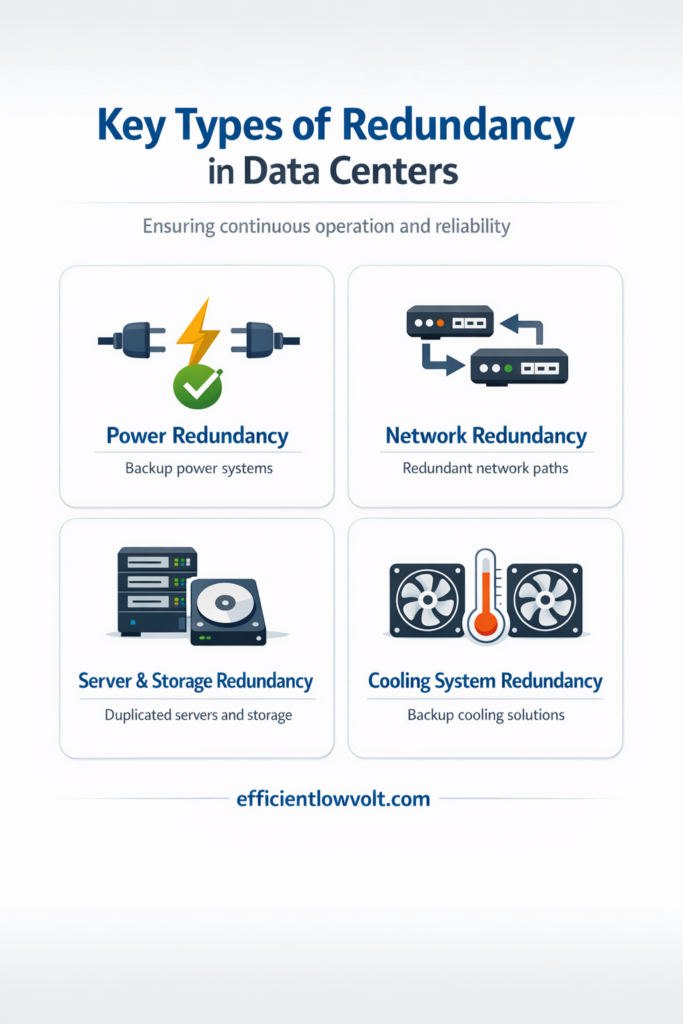
Key Types of Redundancy in Data Centers
A well-designed data center incorporates redundancy at multiple levels. Each layer protects a different aspect of your IT environment.
Power Redundancy
Power interruptions are among the most common causes of data center downtime. Redundant power systems ensure that equipment continues running even if the primary power source fails.
Typical power redundancy solutions include:
- Uninterruptible Power Supplies (UPS) that provide instant backup power
- Backup generators that activate during extended outages
- Dual power feeds from separate electrical sources
- Redundant power distribution units
These systems work together to ensure that servers and networking equipment remain operational even during unexpected electrical failures.
Network Redundancy
Network connectivity is another critical component of business continuity. If a network switch, router, or connection fails, it can disrupt access to applications and data.
Network redundancy helps prevent this by providing alternate paths for data traffic.
Examples of network redundancy include:
- Multiple network switches
- Redundant fiber or Ethernet connections
- Automatic failover routing
- Diverse internet service providers
With these safeguards in place, network traffic can quickly reroute through an alternate path if one connection becomes unavailable.
Server and Storage Redundancy
Servers and storage systems host the applications and data that businesses rely on every day. A failure in these systems can halt operations unless backup resources are available.
Redundant server and storage strategies often include:
- Server clustering, where multiple servers share workloads
- RAID storage configurations, which protect against disk failure
- Virtual machine failover systems
- Real-time data replication
These technologies ensure that critical applications remain accessible even when hardware components fail.
Cooling System Redundancy
Data centers generate significant heat due to the continuous operation of servers and networking equipment. Without proper data center cooling, systems can overheat and shut down.
Redundant cooling systems help maintain safe operating temperatures by ensuring backup cooling capacity is available if one unit fails.
This may include:
- Additional HVAC units
- Redundant cooling loops
- Backup air handling systems
- Environmental monitoring systems
Maintaining stable temperatures protects equipment performance and extends the lifespan of critical hardware.
Redundancy Design Models Explained
Redundancy is often implemented using specific design models that define how backup systems are structured.
N+1 Redundancy
In an N+1 configuration, the system includes one additional component beyond what is required for normal operation.
For example:
- If a data center needs three cooling units to operate efficiently, an N+1 setup would install four units.
If one unit fails, the extra unit ensures the system continues functioning.
2N Redundancy
A 2N configuration doubles the required infrastructure, providing a fully independent backup system.
For example:
- Two complete power systems
- Two separate network paths
- Two independent cooling infrastructures
This design offers a higher level of reliability but typically involves greater upfront investment.
N+2 Redundancy
An N+2 configuration includes two additional backup components instead of one.
This design provides extra resilience for environments where uptime is extremely critical.
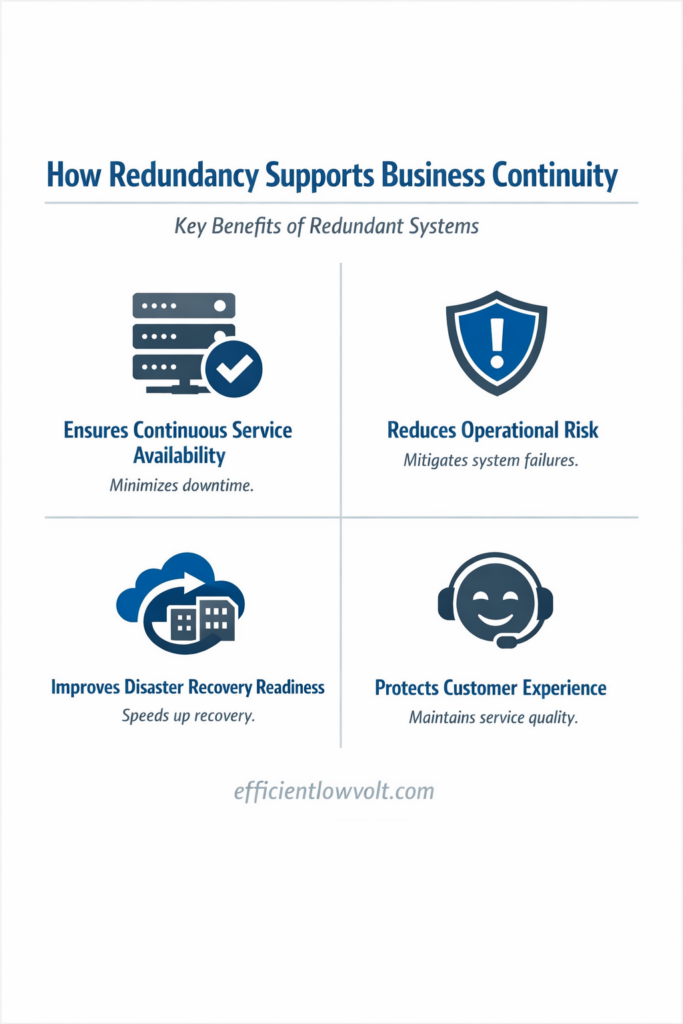
How Redundancy Supports Business Continuity
Business continuity refers to an organization’s ability to maintain operations during disruptions. Redundant infrastructure plays a crucial role in achieving this goal.
Here are several ways redundancy directly supports business continuity:
1. Ensures Continuous Service Availability
Redundant systems automatically take over when failures occur, allowing applications and services to remain accessible to employees and customers.
2. Reduces Operational Risk
By eliminating single points of failure, businesses significantly reduce the likelihood of unexpected downtime.
3. Improves Disaster Recovery Readiness
Redundancy supports disaster recovery strategies by ensuring that systems can continue operating even during equipment failures or localized disruptions.
4. Protects Customer Experience
Customers expect reliable digital services. Redundant infrastructure helps businesses maintain consistent service delivery and avoid frustrating outages.
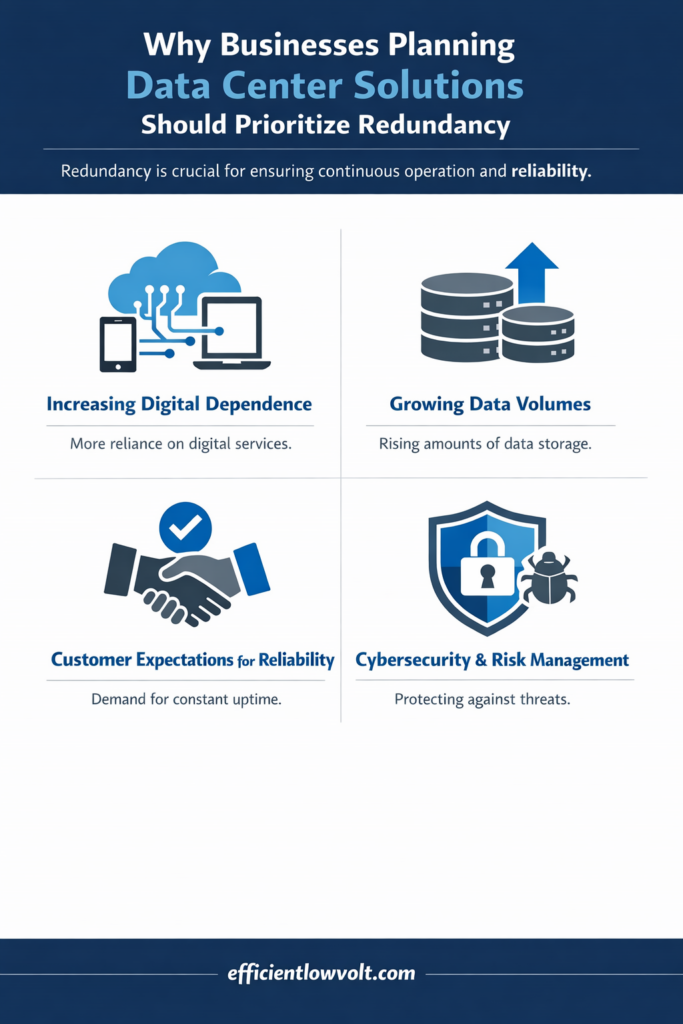
Why Businesses Planning Data Center Solutions Should Prioritize Redundancy
Organizations that are planning to build or upgrade their data infrastructure should treat redundancy as a fundamental design principle rather than an optional feature.
Several factors make redundancy especially important today.
Increasing Digital Dependence
Most business operations now rely on digital platforms, cloud services, and data-driven systems. A failure in IT infrastructure can affect nearly every department.
Growing Data Volumes
Businesses generate and store more data than ever before. Protecting that data requires resilient infrastructure that can withstand hardware failures.
Customer Expectations for Reliability
Customers expect services to be available at all times. Even short outages can lead to dissatisfaction and lost trust.
Cybersecurity and Risk Management
Redundant systems can also improve security resilience by allowing businesses to isolate compromised components without shutting down operations.
Best Practices for Implementing Data Center Redundancy
When designing a redundant infrastructure, careful planning is essential. Simply adding extra equipment is not enough—systems must be configured properly to ensure seamless failover.
Consider the following best practices:
- Assess Critical Systems: Identify which applications and services are most important to your business operations. Prioritize redundancy for these systems.
- Eliminate Single Points of Failure: Review your infrastructure to identify areas where a single component failure could cause downtime.
- Design for Scalability: Redundant systems should support future expansion as your business grows.
- Monitor Infrastructure Continuously: Monitoring tools help detect issues early and ensure backup systems are functioning correctly.
- Test Failover Procedures: Regular testing ensures that redundant systems activate properly when needed.
The Long-Term Value of Redundant Data Infrastructure
Although redundancy may increase the initial cost of a data center project, it provides significant long-term benefits.
Businesses that invest in redundant infrastructure gain:
- Greater operational stability
- Reduced risk of financial losses due to downtime
- Improved disaster recovery capabilities
- Stronger customer confidence
- Scalable infrastructure for future growth
Ultimately, redundancy is not just about preventing failures—it is about creating a reliable foundation for digital business operations.
Building a More Resilient Data Environment
As businesses continue to depend on digital technologies, the need for resilient IT infrastructure becomes more important than ever. Data center redundancy ensures that critical systems remain available even when unexpected issues arise.
By implementing redundancy across power, network, server, and cooling systems, organizations can protect their operations, safeguard customer experiences, and support long-term growth.
Ready to Strengthen Your Data Infrastructure?
We hope this article helped you better understand how data center redundancy supports reliable and continuous business operations.
If you are planning a new data center environment or upgrading your existing infrastructure, having the right design and implementation strategy can make a significant difference in performance and reliability.
At Efficient LowVolt Solutions, we specialize in designing and implementing reliable low-voltage and data infrastructure systems tailored to your business needs. From structured cabling and network systems to scalable data center environments, our team focuses on delivering solutions that support long-term efficiency and stability.
If you have questions about data center redundancy or infrastructure planning, our team is always ready to help. Feel free to contact Efficient LowVolt Solutions anytime to learn how we can support your business with dependable and future-ready technology solutions.